Imagine stepping onto your patio on a sweltering summer day, not to be met with stifling heat, but with a refreshing, cool breeze. Outdoor misting fans make this dream a reality, transforming your backyard into a comfortable oasis. Combining the power of a traditional fan with a fine mist of water, these innovative devices offer a practical and efficient solution to combat rising temperatures, allowing you to reclaim your outdoor living spaces.
Whether you’re hosting a barbecue, enjoying a quiet afternoon with a book, or simply seeking relief from the sun, the right outdoor misting fan can make all the difference. This comprehensive guide will explore everything you need to know about selecting, using, and maintaining the best outdoor misting fan for your patio, ensuring endless hours of cool comfort.
Understanding How Misting Fans Keep You Cool
Misting fans utilize a scientific principle called evaporative cooling, which is the same natural process your body uses to cool itself through sweat. These fans draw in warm ambient air while simultaneously spraying a super-fine mist of water from specialized nozzles. As these tiny water droplets encounter the warm, dry air, they quickly absorb heat energy and turn into vapor, or “flash evaporate.” This process removes heat from the air, causing the surrounding temperature to drop significantly, often by 10 to 30 degrees Fahrenheit, depending on the climate’s humidity.
High-pressure pumps, typically generating around 1000 PSI, are key to creating the ultra-fine mist that evaporates rapidly without soaking surfaces. This ensures that you feel a cool, refreshing breeze rather than getting drenched. The fan then circulates this newly cooled air, extending the refreshing effect across your patio or outdoor space. This ingenious method offers an energy-efficient way to achieve a noticeable temperature reduction, making even the hottest days enjoyable outdoors.
Types of Outdoor Misting Fans for Every Patio
The market offers a diverse range of outdoor misting fans, each designed to suit different needs, patio sizes, and aesthetic preferences. Understanding these types can help you pinpoint the perfect cooling solution for your space.
Portable Misting Fans
- Pros: Offer ultimate flexibility and can be easily moved to any location where cooling is needed, from a small balcony to a camping trip. Many models are battery-operated, providing cordless convenience.
- Cons: Often have smaller water reservoirs, requiring more frequent refills, and may have less powerful airflow compared to larger units.
- When to Use: Ideal for personal use, small gatherings, temporary setups, or situations where you need cooling in multiple, changing locations. Examples include the Geek Aire Battery-Operated Outdoor Misting Fan and the Ryobi USB Lithium Misting Fan Kit.
|
Our Picks for the Best electric fan in 2026
As an Amazon Associate I earn from qualifying purchases.
|
||
| Num | Product | Action |
|---|---|---|
| 1 | Dreo Fan for Bedroom, 120° Oscillating Standing Fans, Quiet Floor Fan with DC Motor, 100ft Pedestal Fans for Room, 9 Speeds, 4 modes, 20dB, 120° Manual Vertical, 37-42\" Adjustable Height, 9H Timer |

|
| 2 | Dreo Tower Fan for Bedroom, 90° Oscillating Standing Fans for Room with 4 Speeds, 3 Modes, 28dB Quiet for Sleep, 25ft/s Velocity, 8H Timer, Remote, Living Room, Office, Home, Black |
|
| 3 | Amazon Basics 16\" Pedestal Fan with Remote, Floor Fan, Standing Fan for Bedroom, Living Room, Office, with 3 Speeds, 3 Modes, Timer, Dual-Layered Blades, Adjustable Height, Tilt Head, 60W, Black |
|
| 4 | Dreo Fan for Bedroom, 12 Inches, 70ft Powerful Airflow, 28db Quiet Table Air Circulator Fans for Whole Room, 120° Adjustable Tilt, 3 Speeds, Desktop Fan for Home, Office, Kitchen |
|
| 5 | Dreo Tower Fan for Bedroom, 25ft/s Velocity Quiet Floor Fan, 90° Oscillating Fans for Indoors with 4 Speeds, 4 Modes, 8H Timer, Standing Fans, Bladeless Fan, Black, Nomad One (DR-HTF007) |
|
| 6 | Amazon Basics 20\" High Velocity Industrial Fan, Floor Fan, with 3 Speeds, Tilt Head, ETL-Listed Safety Compliance, Metal Housing/Blades, Ideal for Industrial/Commercial Space/Garage/Gym, 125W, Black |
|
| 7 | Lasko 2520 Oscillating Stand Fan,White 16 Inch |
|
| 8 | LEVOIT Tower Fan for Bedroom, 25ft/s Velocity Standing Fan with 28dB Quiet for Sleep, Remoter, 12H Timer, 5 Speeds, 4 Modes, 90° Oscillation for Home, Office, Indoor, Bladeless 36 inch, White |
|
| 9 | 10\" Modern Standing Fan for Bedroom, Sleek Oscillating Pedestal Fan, 3-Speed & Height Adjustable Compact Floor Fan for Home Office & Dorm |
|
| 10 | Amazon Basics Air Circulator Fan, Desk Fan for Bedroom, Home and Office, With 90-Degree Tilt Head, 3 Speed Settings, Lightweight (3 LBS), 35 Watts, Black, 11.1\"W x 6.3\"D x 10.9\"H |
|
Pedestal Misting Fans
- Pros: Versatile in height and positioning, offering wider coverage than personal fans. Many include oscillation features to distribute mist evenly.
- Cons: Require a stable surface and often an electrical outlet, limiting placement options compared to battery-powered portables.
- When to Use: Excellent for cooling seating areas, outdoor dining tables, or larger patio sections where you need adjustable, directional airflow. The Shark FlexBreeze Fan with InstaCool is a popular choice for its dual pedestal/tabletop functionality.
Wall-Mounted Misting Fans
- Pros: Space-saving, as they don’t occupy floor space. Can provide targeted cooling from an elevated position, often with oscillation for broader coverage.
- Cons: Require permanent installation and a fixed water and power source, making them less flexible for rearrangement.
- When to Use: Best for patios with limited floor space, designated outdoor kitchens, or areas where you need continuous, overhead cooling without obstruction.
Tower Misting Fans
- Pros: Slim, vertical design is aesthetically pleasing and takes up minimal footprint. Often come with oscillation features for broad area coverage.
- Cons: May not offer the same powerful airflow or mist range as some larger pedestal fans. Height is usually fixed.
- When to Use: Suitable for modern patios or tight spaces where you want discreet cooling that blends with contemporary decor. The Lasko Misto 42″ Outdoor Misting Tower Fan is a notable example.
Misting Fan Conversion Kits
- Pros: An economical way to add misting capabilities to an existing outdoor fan. Easy to install and allows you to utilize equipment you already own.
- Cons: The quality of the mist and overall performance depend heavily on the existing fan. May not be as durable or integrated as purpose-built misting fans.
- When to Use: A budget-friendly option for those who already have a robust outdoor fan and want to experiment with misting without a significant investment. The Homenote Fan Misting Kit is a well-regarded conversion kit.
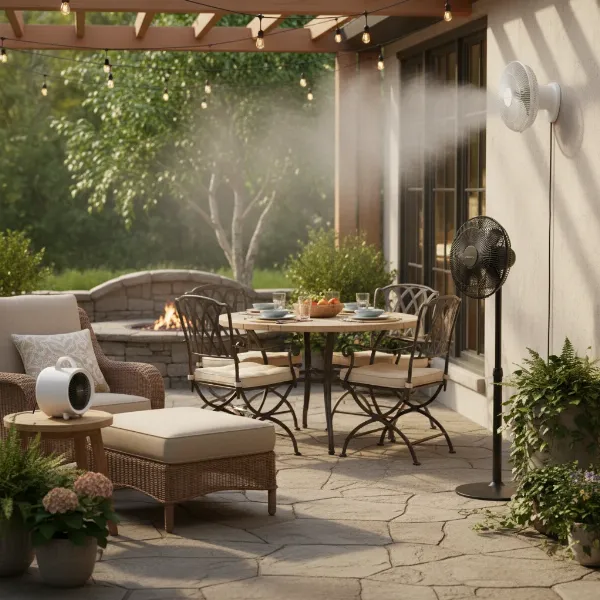 An outdoor patio with various types of misting fans: a portable fan on a table, a pedestal fan near a lounge chair, and a wall-mounted fan near a dining area, all subtly emitting fine mist to cool the space on a sunny day.
Key Features to Consider When Buying a Misting Fan
Choosing the perfect outdoor misting fan involves evaluating several critical features that impact performance, convenience, and durability.
Power and Coverage (CFM & PSI)
The Cubic Feet per Minute (CFM) rating indicates the volume of air the fan moves, directly correlating to its cooling reach. Higher CFM generally means a larger area can be cooled. For the misting function, Pounds per Square Inch (PSI) of the pump is vital.
- High-pressure misting fans (800-1000 PSI): Produce an ultra-fine mist that evaporates almost instantly, providing powerful cooling without significant dampness. Ideal for large areas and drier climates.
- Mid-pressure misting fans (160-200 PSI): Offer a good balance of cooling effectiveness and affordability, suitable for medium-sized patios.
- Low-pressure misting fans (50-80 PSI): Generate a gentler mist, best for arid climates or smaller personal spaces where a slight dampness is acceptable.
Water Source Options
- Hose Connection: Many misting fans connect directly to a standard garden hose, providing a continuous water supply for uninterrupted operation. This is convenient for fixed patio setups.
- Built-in Water Tank: Offers greater portability as the fan is not tethered to a hose. Tank size affects runtime; larger tanks allow for longer use between refills. Some models allow you to add ice to the tank for extra cooling.
- Bucket-Top Systems: Certain battery-powered fans are designed to sit atop a standard five-gallon bucket, drawing water from it. These are excellent for camping or events where a hose connection isn’t available.
Portability and Mounting Options
Consider how and where you’ll use the fan. Portable fans with wheels, handles, or lightweight designs offer maximum flexibility. Wall-mounted options save space but are fixed. Some fans can convert between pedestal and tabletop modes, like the Shark FlexBreeze, offering versatile placement.
Fan Speed Controls and Oscillation
Multiple speed settings allow you to adjust the airflow intensity to your comfort level and ambient conditions. Oscillation is a highly beneficial feature, as it enables the fan head to move back and forth, distributing the cool mist over a wider area and ensuring more even cooling for everyone on the patio.
Durability and Weather Resistance
Since these fans operate outdoors, they must withstand the elements. Look for models made from robust, rust-resistant materials like stainless steel or high-quality UV-protected plastics. An IPX4 rating indicates resistance to splashing water, crucial for outdoor use. Safety features like an inline GFCI (Ground Fault Circuit Interrupter) plug are also important to prevent electrical hazards.
Noise Level
For a relaxing patio experience, a quiet operation is key. Check the decibel (dB) rating if available; lower numbers indicate a quieter fan. Some powerful fans, especially on high settings, can be quite noisy, which might disrupt conversations or peaceful enjoyment.
Smart Features and Remote Control
Modern misting fans may include smart features such as adjustable mist levels, programmable timers, or remote controls for convenient operation. Some high-end models even offer Bluetooth connectivity.
Top Misting Fan Categories & Brands
While specific product models evolve, several brands consistently deliver quality outdoor misting fans across different categories.
For All-Around Versatility
Brands like Shark (e.g., FlexBreeze) often lead with hybrid designs that combine corded and cordless operation, pedestal and tabletop configurations, and effective misting. These are excellent for homeowners seeking a single fan for various outdoor and even indoor needs.
For Powerful, Wide-Area Cooling
When you need serious cooling for a large patio or commercial space, look for robust models from brands like EGO Power+ or dedicated misting system providers like MistAmerica. These typically feature high CFM ratings and efficient misting capabilities, sometimes requiring a bucket water source.
For Portable, Battery-Powered Convenience
Brands such as Geek Aire and Ryobi excel in battery-operated misting fans that offer cordless freedom. These are perfect for tailgating, gardening, or moving cooling wherever it’s needed without worrying about power outlets or hose connections.
For Budget-Friendly Solutions
Entry-level options and misting conversion kits from brands like HOMENOTE offer an affordable entry point into outdoor misting, allowing you to enhance an existing fan or create a basic misting setup without breaking the bank.
Choosing the Right Outdoor Misting Fan: A Buying Guide
Making the best choice requires a clear understanding of your specific needs and environment.
1. Assess Your Outdoor Space
- Size: Measure your patio or the area you want to cool. A small balcony needs a personal or compact fan, while a sprawling backyard benefits from a powerful pedestal or wall-mounted unit with wide coverage.
- Layout: Consider the placement of furniture, obstacles, and existing power/water sources. This will help determine if you need a portable, freestanding, or mounted solution.
- Climate: Misting fans are most effective in hot, dry climates where evaporation happens quickly. In extremely humid environments, their cooling effect might be reduced, though the airflow still provides relief.
2. Determine Your Budget
Outdoor misting fans vary widely in price, from simple hose-linked kits under $50 to high-end, self-contained units costing several hundred dollars or even professional systems in the thousands. Balance desired features and performance with your financial comfort.
3. Read Reviews and Research Brands
Look for feedback from other users regarding performance, durability, ease of use, and noise levels. Reputable brands often have established customer support and better warranty policies.
4. Prioritize Key Features
Decide which features are most important to you:
- Maximum Cooling: Focus on high CFM and PSI.
- Portability: Emphasize battery life and lightweight design.
- Quiet Operation: Check decibel ratings.
- Ease of Installation: Consider hose-ready kits versus systems requiring more setup.
“A well-chosen outdoor misting fan can extend your outdoor living season by months. It’s about creating a microclimate that makes your patio enjoyable, even when the rest of the world is sweltering.” – Maria Conti, Home Improvement Specialist
Tips for Using and Maintaining Your Misting Fan
Proper use and regular maintenance will ensure your outdoor misting fan operates efficiently and lasts for many seasons.
Setting Up for Optimal Cooling
- Strategic Placement: Position the fan to direct mist towards your primary seating or activity area. For larger spaces, multiple fans might be necessary.
- Consider Humidity: On very humid days, you might use the fan without the misting function to avoid excessive dampness, or opt for an intermittent mist setting.
- Water Quality: If you live in an area with hard water, consider using a water filter on your hose connection to prevent mineral buildup and clogging in the misting nozzles. Some fans have built-in filters.
Cleaning and Storage
- Regular Cleaning: Periodically clean the fan blades and misting nozzles to remove dust, dirt, and mineral deposits. Always unplug the fan before cleaning. Use a soft cloth and mild soap for the exterior. For nozzles, follow manufacturer instructions, which may involve soaking in vinegar to dissolve buildup.
- Winter Storage: Before storing the fan for the off-season, ensure it is thoroughly cleaned and completely dry to prevent mold, mildew, and corrosion. Drain any water from tanks or lines. Store it in a dry, protected area.
Troubleshooting Common Issues
- Clogged Nozzles: The most common issue. Often resolved by cleaning or soaking nozzles in a descaling solution (like vinegar).
- Reduced Mist Output: Check water pressure, ensure no kinks in the hose, and clean nozzles. For tank models, ensure adequate water level.
- Fan Not Working: Check power connection, battery charge, and any safety switches. Consult the user manual for specific troubleshooting steps.
Conclusion
Embracing the warmth of summer doesn’t mean sacrificing comfort on your patio. With the right outdoor misting fan, you can create a cool, inviting retreat that extends your enjoyment of outdoor living. From understanding the magic of evaporative cooling to selecting the ideal type and features for your space, a misting fan offers an efficient, cost-effective, and refreshing solution. By choosing wisely and performing simple maintenance, your patio can become the ultimate cool haven all season long.
What kind of outdoor experience do you dream of, and how can a misting fan help you achieve it?
Frequently Asked Questions
Can outdoor misting fans be used in all climates?
Outdoor misting fans are most effective in hot, dry climates where the water evaporates quickly, leading to a significant temperature drop. In high-humidity environments, their cooling efficiency may be somewhat reduced, but the airflow still provides a welcome breeze. Some manufacturers design models specifically for higher humidity conditions.
How much water do misting fans use?
The water consumption of misting fans varies by model and pressure system. High-pressure systems often create a finer mist that uses less water per hour (e.g., 1-2 gallons per hour for an average-sized system) compared to low-pressure systems which might use more or create larger droplets. Overall, they are considered water-efficient compared to other cooling methods for large outdoor spaces.
Do misting fans attract bugs or pests?
Generally, the fine mist from these fans can actually deter flying insects like mosquitoes, wasps, and bees. The water droplets cling to their wings, making it difficult for them to fly through the misted area. However, it’s a deterrent, not a pest control solution, so they may simply avoid the misted zone rather than being eliminated.
How safe are outdoor misting fans around children and pets?
When used as directed, outdoor misting fans are generally safe. Ensure the fan is placed on a stable surface to prevent tipping and that electrical cords are properly secured to avoid tripping hazards. Many outdoor-rated fans come with GFCI plugs for added electrical safety. Always supervise children and pets around any electrical appliance.
Is it difficult to install an outdoor misting fan?
Installation difficulty varies by type. Simple hose-linked misting kits are typically very easy to install, often just requiring attachment to a garden hose and securing nozzles. Freestanding or portable units usually require minimal assembly. Wall-mounted or more complex high-pressure systems might require more involved setup, though many are designed for DIY installation with basic tools.