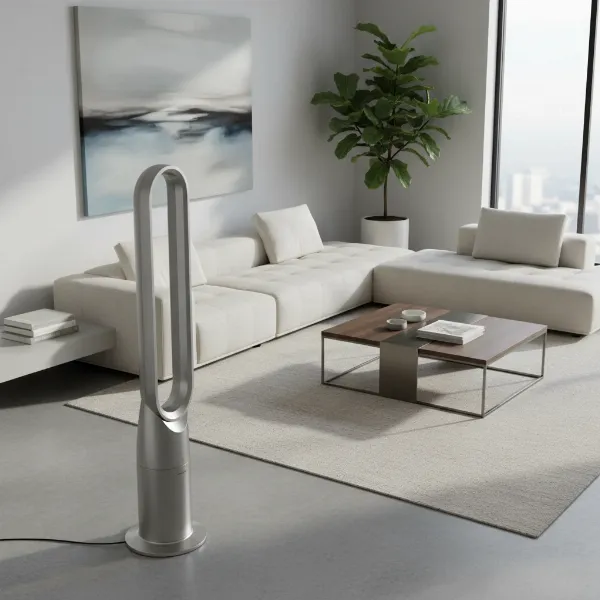
In today’s interconnected world, your home does more than just provide shelter; it anticipates your needs, responds to your voice, and manages comfort with remarkable intelligence. Among the many innovations transforming living spaces, the smart electric fan stands out as a simple yet powerful upgrade. No longer just a manual appliance, modern smart fans offer effortless control, enhanced comfort, and energy efficiency, all through the convenience of your favorite voice assistants like Amazon Alexa and Google Home. If you’re ready to embrace a cooler, smarter living experience, this comprehensive guide will help you navigate the best options available.
Types of Smart Fans Compatible with Alexa and Google Home
Smart fans come in various forms, each designed to meet specific cooling needs and seamlessly integrate into your smart home ecosystem. Understanding the distinctions will help you choose the perfect fit for your space.
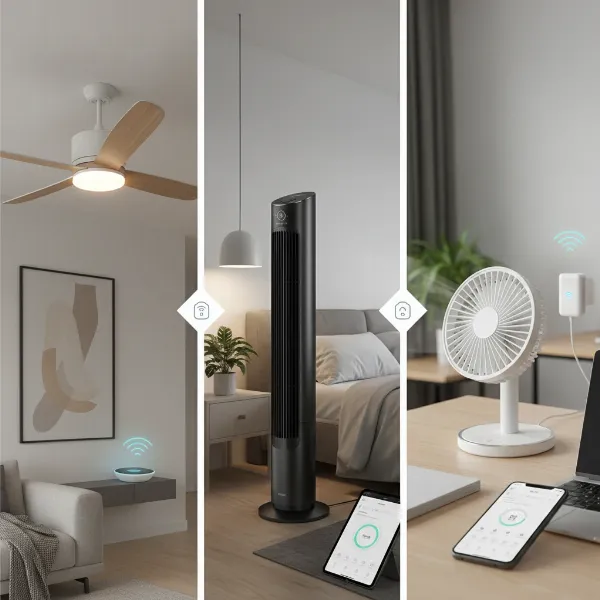 various smart fan types integrated into a modern smart home environment
Smart Ceiling Fans
Smart ceiling fans replace traditional fixtures, offering powerful whole-room air circulation and often incorporating advanced lighting features.
- Pros of Smart Ceiling Fans: These fans provide robust airflow suitable for larger areas like living rooms and master bedrooms. Many models include integrated LED lighting with adjustable brightness and color temperature, allowing you to customize the ambiance with a voice command. Their permanent installation means they are always available and never take up floor space. Brands like Dreo and Modern Forms offer excellent smart ceiling fan options. The Honeywell Xerxes is a powerful option for large rooms, though some models may require a separate hub for full smart functionality.
- Cons of Smart Ceiling Fans: Installation can be more involved, especially if you’re replacing an older fixture or installing in a new location, potentially requiring professional help. Smart ceiling fans also tend to be among the pricier smart fan options.
- When to Choose a Smart Ceiling Fan: Opt for a smart ceiling fan if you need powerful, widespread cooling and lighting for a large room, or if you want to elevate the aesthetic and functionality of a central living space or even a covered outdoor patio.
|
Our Picks for the Best electric fan in 2026
As an Amazon Associate I earn from qualifying purchases.
|
||
| Num | Product | Action |
|---|---|---|
| 1 | LEVOIT Tower Fan for Bedroom, 25ft/s Velocity Standing Fan with 28dB Quiet for Sleep, Remoter, 12H Timer, 5 Speeds, 4 Modes, 90° Oscillation for Home, Office, Indoor, Bladeless 36 inch, White |

|
| 2 | Dreo Tower Fan for Bedroom, 90° Oscillating Standing Fans for Room with 4 Speeds, 3 Modes, 28dB Quiet for Sleep, 25ft/s Velocity, 8H Timer, Remote, Living Room, Office, Home, Black |
|
| 3 | Dreo Tower Fan for Bedroom, 25ft/s Velocity Quiet Floor Fan, 90° Oscillating Fans for Indoors with 4 Speeds, 4 Modes, 8H Timer, Standing Fans, Bladeless Fan, Black, Nomad One (DR-HTF007) |
|
| 4 | 10\" Modern Standing Fan for Bedroom, Sleek Oscillating Pedestal Fan, 3-Speed & Height Adjustable Compact Floor Fan for Home Office & Dorm |
|
| 5 | Amazon Basics 20\" High Velocity Industrial Fan, Floor Fan, with 3 Speeds, Tilt Head, ETL-Listed Safety Compliance, Metal Housing/Blades, Ideal for Industrial/Commercial Space/Garage/Gym, 125W, Black |
|
| 6 | Dreo Fan for Bedroom, 12 Inches, 70ft Powerful Airflow, 28db Quiet Table Air Circulator Fans for Whole Room, 120° Adjustable Tilt, 3 Speeds, Desktop Fan for Home, Office, Kitchen |
|
| 7 | Dreo Fan for Bedroom, 120° Oscillating Standing Fans, Quiet Floor Fan with DC Motor, 100ft Pedestal Fans for Room, 9 Speeds, 4 modes, 20dB, 120° Manual Vertical, 37-42\" Adjustable Height, 9H Timer |
|
| 8 | Amazon Basics 16\" Pedestal Fan with Remote, Floor Fan, Standing Fan for Bedroom, Living Room, Office, with 3 Speeds, 3 Modes, Timer, Dual-Layered Blades, Adjustable Height, Tilt Head, 60W, Black |
|
| 9 | Lasko 2520 Oscillating Stand Fan,White 16 Inch |
|
| 10 | Amazon Basics Air Circulator Fan, Desk Fan for Bedroom, Home and Office, With 90-Degree Tilt Head, 3 Speed Settings, Lightweight (3 LBS), 35 Watts, Black, 11.1\"W x 6.3\"D x 10.9\"H |
|
Smart Tower and Pedestal Fans
These freestanding fans offer targeted cooling with portability, making them versatile additions to any room.
- Pros of Smart Tower and Pedestal Fans: Tower fans are known for their sleek, space-saving design, while pedestal fans offer adjustable height, allowing you to direct airflow precisely. Many smart tower and pedestal fans, such as the Dreo Pilot Max Tower Fan and Dreo Smart Air Circulator PolyFan 704S, are exceptionally quiet, operating at levels as low as 25dB (like a whisper), making them ideal for bedrooms. They often feature wide oscillation patterns, scheduling capabilities, and multiple fan modes.
- Cons of Smart Tower and Pedestal Fans: While providing excellent localized cooling, they generally can’t match the whole-room circulation of a powerful smart ceiling fan. High-end models, particularly those with air purification, can also be quite expensive.
- Ideal Uses for Smart Tower and Pedestal Fans: These fans are perfect for bedrooms, home offices, or living areas where you need direct, adjustable cooling and the flexibility to move the fan between rooms. Their ability to integrate with voice assistants makes controlling them from across the room effortless.
Smart Desk and Air Circulator Fans
Compact and highly portable, smart desk fans are designed for personal cooling in smaller spaces.
- Pros of Smart Desk and Air Circulator Fans: Small footprint and easy to move, making them ideal for desktops, nightstands, or small shelves. Many, like the Dreo Falcon S CF714S Air Circulator, offer impressive airflow for their size, with horizontal and vertical oscillation. Affordable smart desk fans, such as the Windmill Fan, provide basic smart features like app and voice control for budget-conscious users. Some even include temperature sensors to adjust automatically.
- Cons of Smart Desk and Air Circulator Fans: Their smaller size limits their cooling capacity to personal spaces or very small rooms. Some budget options may lack advanced features like oscillation or can get loud at higher speeds.
- Best Scenarios for Smart Desk Fans: These are excellent for individual users seeking direct airflow at a workstation, in a small dorm room, or to supplement ambient cooling in a child’s bedroom.
Smart Air Purifying Fans
Combining air circulation with air filtration, these dual-purpose fans offer a healthier and cooler environment.
- Pros of Smart Air Purifying Fans: Brands like Dyson (e.g., Dyson Purifier Cool TP07) integrate HEPA and carbon filters to capture allergens, dust, pollutants, and odors while simultaneously providing cooling airflow. This is a significant benefit for individuals with allergies, asthma, or anyone concerned about indoor air quality. They offer comprehensive app control, air quality monitoring, and voice assistant compatibility.
- Cons of Smart Air Purifying Fans: These fans are typically the most expensive category of smart fans due to their advanced filtration technology. While effective, some models can become noisy at their highest fan settings.
- Why Consider an Air Purifying Smart Fan: If you prioritize both cooling and cleaner air, especially in areas with pets, pollen, or other airborne irritants, a smart air purifying fan offers a premium, all-in-one solution for your smart home.
Key Features and Considerations for Alexa/Google Home Smart Fans
When selecting a smart fan for your Alexa or Google Home setup, certain features are paramount to ensure seamless integration and optimal performance.
Connectivity and Voice Control
The cornerstone of any smart fan is its ability to connect to your home network and respond to voice commands.
- Wi-Fi Connectivity: Most smart fans use your home’s Wi-Fi network (typically 2.4GHz) for connectivity. Ensure your home network is stable and can reach the fan’s intended location.
- Alexa/Google Assistant Integration: Verify that the fan explicitly supports both Amazon Alexa and Google Assistant. This allows you to use voice commands like, “Alexa, turn on the living room fan,” or “Hey Google, set the bedroom fan to speed 4.” This hands-free control is a primary advantage of smart fans.
- Companion App: A robust and intuitive smartphone app is crucial. While voice assistants handle basic commands, the app provides deeper control over settings, custom modes, and often firmware updates. For instance, the Govee app is praised for automatically adding new devices once connected to your smart home ecosystem.
App Functionality and Scheduling
Beyond basic on/off, a good smart fan app unlocks a suite of convenient controls.
- Scheduling and Timers: The ability to schedule your fan to turn on or off at specific times, or to set a timer for automatic shutdown, is key for energy savings and comfort. You can program it to cool your room before you arrive home or turn off after you’ve fallen asleep.
- Multiple Modes and Speeds: Look for fans offering a variety of fan speeds (often 9-12 or more) and operational modes like Normal, Sleep, Nature (mimics a natural breeze), and Auto. Some apps even allow for DIY custom modes.
- Oscillation Control: Advanced apps let you precisely adjust the oscillation angle of tower or desk fans, directing airflow exactly where it’s needed, or turning oscillation off entirely.
Airflow, Noise Level, and Modes
Performance metrics are vital for comfort.
- Airflow (CFM): Measured in cubic feet per minute (CFM), this indicates how much air the fan can move. Match the CFM rating to your room size for effective cooling. Larger rooms require higher CFM.
- Noise Level (dB): For bedrooms or quiet workspaces, a low noise level is critical. Many smart fans boast whisper-quiet operation (e.g., under 30dB on low settings).
- Special Modes: “Sleep mode” reduces noise and light for undisturbed rest, while “Auto mode” often adjusts fan speed based on ambient room temperature.
Additional Smart Features (e.g., Sensors, Lighting)
Many smart fans offer more than just basic cooling.
- Temperature and Humidity Sensors: Some fans include built-in sensors that allow them to automatically adjust their speed based on the room’s temperature or humidity levels, enhancing comfort and efficiency.
- Integrated LED Lighting: Particularly common in smart ceiling fans, integrated LED lights can offer dimming capabilities, adjustable color temperatures (from warm white to cool daylight), or even full RGB color options for mood lighting, all controllable via app or voice. Some even feature “anti-theft” modes that simulate occupancy by cycling lights on and off.
- Air Purification: As seen with Dyson, some smart fans incorporate advanced filtration systems to improve indoor air quality.
Energy Efficiency
Smart fans often feature energy-saving technologies.
- DC Motors: Many modern smart fans utilize energy-efficient DC (direct current) motors, which consume less power than traditional AC motors.
- Smart Automation: Features like scheduling, timers, and auto-mode based on temperature sensors directly contribute to energy savings by ensuring the fan only runs when and how it’s needed.
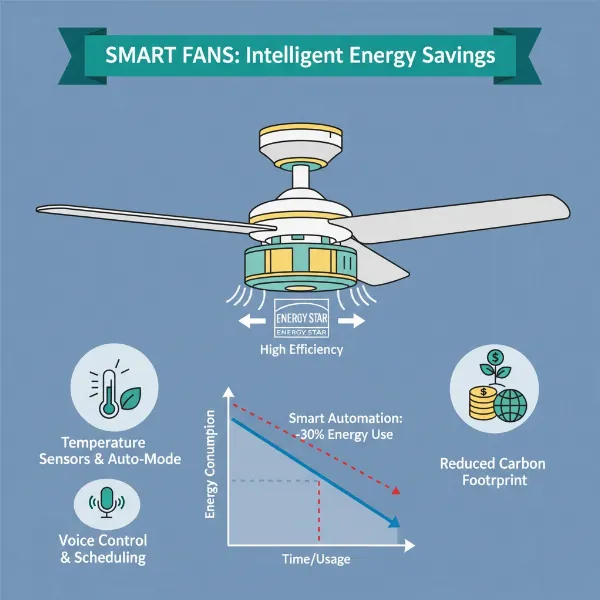 visualizing smart fan energy efficiency with dc motors and automation
Comparison Table: Top Smart Fans for Your Connected Home
Here’s a quick look at some highly-rated smart fans compatible with Alexa and Google Home, highlighting their key attributes:
| Model | Type | Key Features | Alexa/Google Home | Price Range | Noise Level | Notable Pros |
|---|---|---|---|---|---|---|
| Dreo CLF521S Smart Ceiling Fan | Ceiling | Powerful airflow, adjustable LED light, 12 speeds, remote | Yes | Mid-range | Quiet | Affordable for a smart ceiling fan, strong airflow |
| Dreo Pilot Max Tower Fan | Tower | Ultra-quiet (25dB), 120° oscillation, auto mode, sleek design | Yes | Mid-range | Very Quiet | Excellent for large rooms, whisper-quiet operation |
| Dyson Purifier Cool TP07 | Air Purifying | HEPA & carbon filtration, 10 speeds, wide oscillation, air quality monitoring | Yes (incl. Siri) | High-end | Variable | Superior air purification, comprehensive app control |
| Govee Smart Tower Fan 2 Max | Tower | RGB night light, 5 modes, customizable oscillation, scheduler | Yes | Budget-Mid | Moderate | Fun ambient lighting, easy Alexa/Google integration |
| Modern Forms Renegade Smart Fan | Ceiling | 8 blades, 6 speeds, LED light, weather-resistant | Yes | High-end | Quiet | Indoor/outdoor use, sleek design, works with SmartThings |
| Dreo Smart Air Circulator PolyFan 704S | Pedestal | Strong airflow (110ft), 120° vertical/150° horizontal oscillation, adjustable height | Yes | Mid-range | Quiet (25dB) | Highly versatile oscillation, good for medium rooms |
| Windmill Fan | Desk | Compact design, strong airflow, scheduling | Yes | Budget | Moderate | Very affordable, compact for small spaces |
How to Choose the Right Smart Fan for Your Needs
Selecting the perfect smart fan involves more than just picking a brand. Consider these factors to ensure it meets your specific requirements.
Assess Your Space and Cooling Requirements
- Room Size: A small desk fan might suffice for a personal workspace, while a powerful smart ceiling fan or a robust tower fan is necessary for larger living areas. Look at the fan’s CFM (Cubic Feet per Minute) rating for airflow capacity.
- Ceiling Height: For rooms with low ceilings (under 8 feet), a flush-mount smart ceiling fan is ideal to ensure proper clearance. Higher ceilings benefit from downrod-mounted fans to bring the blades to an optimal height for air circulation.
- Indoor vs. Outdoor: If you need a fan for a covered patio or outdoor living space, ensure it has an appropriate damp or wet rating for weather resistance.
Budgeting for Smart Fan Technology
Smart fans span a wide price range. While some basic smart desk fans can be quite affordable, advanced ceiling fans with integrated lighting or air-purifying models like Dyson can represent a significant investment. Determine what features are essential for you and what premium you’re willing to pay for smart home convenience and integration. Remember that smart features can lead to energy savings over time.
Top Brands and Their Smart Offerings
Several brands consistently deliver high-quality smart fans with robust Alexa and Google Home compatibility:
- Dreo: Known for a wide range of quiet and powerful smart fans, including ceiling, tower, desk, and pedestal models, often offering excellent value.
- Dyson: Specializes in premium air purifying fans with cutting-edge technology and sleek designs, though at a higher price point.
- Govee: Offers innovative smart tower fans, often with unique features like RGB ambient lighting, known for seamless integration.
- Modern Forms: A leader in stylish smart ceiling fans, often designed for both indoor and outdoor use with extensive smart home platform compatibility.
- Hampton Bay (via Hubspace): Offers a range of smart ceiling fans, particularly through Home Depot, with good Alexa and Google Assistant integration via their Hubspace app.
Reading user reviews and professional tests (like those from PCMag or The Spruce) can provide valuable insights into real-world performance and smart home integration.
Understanding Installation and Setup
- Pre-built Smart Fans: Most smart tower, pedestal, and desk fans are plug-and-play, requiring only a simple assembly of the base before connecting to Wi-Fi via their companion app.
- Smart Ceiling Fans: These require electrical wiring and mounting, similar to traditional ceiling fans. Some models simplify the process with features like quick-connect LED kits or snap-in blades, but if you’re uncomfortable with electrical work, professional installation is recommended.
- Converting Existing Fans: Don’t want to buy a new fan? You can “smartify” existing ones:
- Smart Plugs: For any fan that plugs into a wall outlet, a smart Wi-Fi plug can add basic on/off control via app or voice assistant.
- Smart Ceiling Fan Wall Switches: Replace your existing wall switch with a smart version to control your ceiling fan’s speed and light.
- Universal Remote Conversion Kits: Products like the Bond Bridge can “learn” the radio frequencies of your remote-controlled ceiling fans and integrate them into your smart home system, allowing app and voice control without modifying the fan itself.
Maximizing Your Smart Fan Experience with Alexa and Google Home
Once your smart fan is set up, you can unlock its full potential through advanced integration with your smart home ecosystem.
Setting Up Voice Commands and Routines
Voice commands are incredibly convenient. Experiment with different phrases:
- “Alexa, turn on the fan in the living room.”
- “Hey Google, set the bedroom fan to high.”
- “Alexa, turn off all fans.”
You can also create custom routines. For example, a “Good Morning” routine could turn on your bedroom light, open your smart blinds, and set your smart fan to a low, gentle breeze. A “Movie Night” routine might dim the lights and turn on the living room fan to a specific speed.
Integrating with Other Smart Home Devices
The true power of a smart fan lies in its ability to interact with other devices.
- Smart Thermostats: Link your smart fan with a smart thermostat (like an Ecobee) so that when the temperature rises above a certain threshold, the fan automatically turns on to assist with cooling, potentially reducing your AC usage.
- Motion Sensors: Integrate a motion sensor to automatically activate a desk or tower fan when you enter a room and turn it off when no motion is detected for a period.
- Smart Lighting: If your smart fan has integrated lighting, include it in your lighting scenes and schedules for a unified smart home experience.
Tips for Maintenance and Longevity
To keep your smart fan running efficiently and quietly for years:
- Regular Cleaning: Dust can accumulate on blades and grilles, reducing airflow and potentially increasing noise. Clean your fan regularly according to the manufacturer’s instructions. For air purifying fans, replace filters as recommended.
- Firmware Updates: Keep the fan’s firmware updated through its companion app. Updates often bring new features, performance improvements, and security enhancements.
- Proper Storage: If you store seasonal fans, clean them thoroughly and store them in a dry, safe place to prevent dust buildup and damage.
Conclusion
Upgrading to a smart electric fan compatible with Alexa and Google Home is an excellent way to enhance comfort, convenience, and efficiency in your home. From powerful smart ceiling fans that anchor your living space to portable tower fans that offer quiet, targeted cooling, there’s a smart fan solution for every need and budget. By leveraging voice control, advanced app features, and integration with your existing smart home ecosystem, you can create a truly intelligent and responsive environment. Take control of your comfort with ease and step into the future of home cooling.
What kind of smart fan will you choose to transform your home’s climate and convenience?
Frequently Asked Questions
Can I make my existing traditional fan smart?
Yes, you can! For fans that plug into an outlet, a smart Wi-Fi plug will enable basic on/off control via your smartphone or voice assistant. For remote-controlled ceiling fans, a device like the Bond Bridge can learn the remote’s frequencies and integrate the fan into your smart home system.
What is the main difference between a smart fan and a regular fan with a remote?
A smart fan offers much more than just remote control. It connects to your home Wi-Fi, allowing control via a smartphone app from anywhere, voice commands through Alexa or Google Home, scheduling, and integration into broader smart home routines with other devices like thermostats or motion sensors.
Do smart fans use more electricity than traditional fans?
Not necessarily. While they have smart components, many modern smart fans feature energy-efficient DC motors. Additionally, smart features like scheduling, timers, and auto-modes that respond to room temperature can help reduce energy consumption by ensuring the fan only runs when and how it’s genuinely needed.
Are smart fans worth the additional cost?
For many, the convenience, enhanced control, and integration into a smart home ecosystem make smart fans a worthwhile investment. The ability to control your fan with your voice, schedule its operation, and link it with other smart devices can significantly improve daily comfort and potentially lead to energy savings, justifying the higher upfront cost.