As summer temperatures climb and energy bills follow suit, many of us seek effective yet affordable ways to stay cool. Electric fans are a popular choice, offering a refreshing breeze without the significant energy drain of air conditioning. But have you ever stopped to consider exactly how much electricity your fan consumes and what it truly adds to your monthly bill? Understanding the energy costs of your electric fan is crucial for smart home management and maximizing savings while staying comfortable. This comprehensive guide will break down fan electricity usage by type, explain how to calculate costs, and provide actionable tips to keep your cooling expenses in check.
Types of Electric Fans and Their Power Consumption
Electric fans come in various designs, each suited for different needs and spaces, and their power consumption varies accordingly. Generally, most household fans operate within a modest range of 10 to 100 watts, making them far more energy-efficient than larger cooling appliances like air conditioners. The wattage—the rate at which a fan consumes electricity—is a primary determinant of its operating cost.
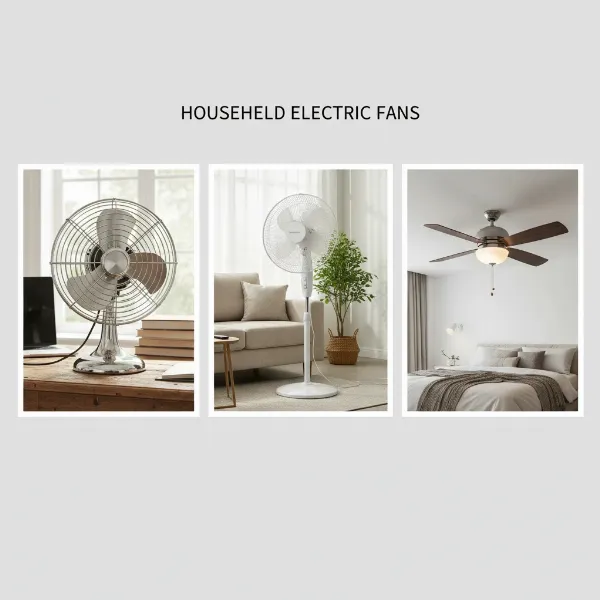 Various types of household electric fans showcasing different designs and sizes.
Desk Fans
Desk fans are small, portable units designed for personal cooling in close proximity. They are highly energy-efficient due to their compact size and smaller motors, making them ideal for individual workspaces or bedside tables. While they offer limited area coverage, their minimal power usage is a significant advantage.
- Typical Wattage: 5-40 watts.
- When to Use: Personal cooling, small spaces, short durations.
|
Our Picks for the Best electric fan in 2026
As an Amazon Associate I earn from qualifying purchases.
|
||
| Num | Product | Action |
|---|---|---|
| 1 | Dreo Fan for Bedroom, 12 Inches, 70ft Powerful Airflow, 28db Quiet Table Air Circulator Fans for Whole Room, 120° Adjustable Tilt, 3 Speeds, Desktop Fan for Home, Office, Kitchen |

|
| 2 | Amazon Basics 20\" High Velocity Industrial Fan, Floor Fan, with 3 Speeds, Tilt Head, ETL-Listed Safety Compliance, Metal Housing/Blades, Ideal for Industrial/Commercial Space/Garage/Gym, 125W, Black |
|
| 3 | 10\" Modern Standing Fan for Bedroom, Sleek Oscillating Pedestal Fan, 3-Speed & Height Adjustable Compact Floor Fan for Home Office & Dorm |
|
| 4 | Dreo Tower Fan for Bedroom, 90° Oscillating Standing Fans for Room with 4 Speeds, 3 Modes, 28dB Quiet for Sleep, 25ft/s Velocity, 8H Timer, Remote, Living Room, Office, Home, Black |
|
| 5 | Dreo Tower Fan for Bedroom, 25ft/s Velocity Quiet Floor Fan, 90° Oscillating Fans for Indoors with 4 Speeds, 4 Modes, 8H Timer, Standing Fans, Bladeless Fan, Black, Nomad One (DR-HTF007) |
|
| 6 | Amazon Basics 16\" Pedestal Fan with Remote, Floor Fan, Standing Fan for Bedroom, Living Room, Office, with 3 Speeds, 3 Modes, Timer, Dual-Layered Blades, Adjustable Height, Tilt Head, 60W, Black |
|
| 7 | Dreo Fan for Bedroom, 120° Oscillating Standing Fans, Quiet Floor Fan with DC Motor, 100ft Pedestal Fans for Room, 9 Speeds, 4 modes, 20dB, 120° Manual Vertical, 37-42\" Adjustable Height, 9H Timer |
|
| 8 | LEVOIT Tower Fan for Bedroom, 25ft/s Velocity Standing Fan with 28dB Quiet for Sleep, Remoter, 12H Timer, 5 Speeds, 4 Modes, 90° Oscillation for Home, Office, Indoor, Bladeless 36 inch, White |
|
| 9 | Amazon Basics Air Circulator Fan, Desk Fan for Bedroom, Home and Office, With 90-Degree Tilt Head, 3 Speed Settings, Lightweight (3 LBS), 35 Watts, Black, 11.1\"W x 6.3\"D x 10.9\"H |
|
| 10 | Lasko 2520 Oscillating Stand Fan,White 16 Inch |
|
Stand/Pedestal Fans
Stand or pedestal fans offer greater flexibility with adjustable height and oscillation features, allowing them to cool a larger area than a desk fan. Their increased size and motor power mean they consume slightly more electricity but provide more widespread airflow, suitable for small to medium-sized rooms.
- Typical Wattage: 40-80 watts.
- When to Use: Medium-sized rooms, general air circulation, flexible placement.
Wall-Mounted Fans
Wall-mounted fans are designed to save floor space while delivering effective cooling. Permanently installed, they can direct airflow across a room without obstruction, making them excellent for crowded areas or rooms where floor space is at a premium. Their wattage is generally comparable to stand fans.
- Typical Wattage: 40-80 watts.
- When to Use: Maximizing floor space, wide area coverage, permanent cooling solutions.
Ceiling Fans
Ceiling fans are a staple in many homes, providing whole-room air circulation that can make a room feel several degrees cooler. They work by creating a wind-chill effect, helping evaporate sweat from the skin. Modern ceiling fans, especially those with DC motors, can be incredibly efficient. They can also be reversed in winter to circulate warm air downwards.
- Typical Wattage: 50-75 watts for standard models; energy-efficient (ENERGY STAR) models can be as low as 28 watts.
- When to Use: Whole-room cooling, year-round air circulation, complementing AC.
Box Fans
Box fans are known for their powerful airflow, often used for circulating air through windows to draw in cool air or expel hot air. They are relatively simple in design but effective for quickly moving a large volume of air, though they can be bulkier and sometimes noisier than other types.
- Typical Wattage: 50-100 watts.
- When to Use: Ventilating rooms, rapid air movement, window placement.
Tower Fans
Tower fans feature a tall, slender design with oscillation, making them a popular choice for modern aesthetics and small spaces. They provide a broad column of air and often come with features like remote controls and multiple speed settings. While not as powerful as some box fans, they offer a comfortable and consistent breeze.
- Typical Wattage: 40-100 watts.
- When to Use: Modern interiors, small footprints, quiet operation.
Comparing Electric Fan Energy Costs: A Detailed Look
Understanding the actual cost of running an electric fan requires a simple calculation. The energy consumption of an appliance is measured in kilowatt-hours (kWh), and your electricity bill charges you per kWh.
To calculate the cost:
- Find the fan’s wattage (W): This is usually on a sticker on the fan or in its manual.
- Convert watts to kilowatts (kW): Divide the wattage by 1000 (e.g., 50W / 1000 = 0.05 kW).
- Calculate daily kWh usage: Multiply kW by the number of hours you run the fan per day.
- Calculate daily cost: Multiply daily kWh usage by your local electricity rate (e.g., $0.15/kWh).
- Calculate monthly cost: Multiply the daily cost by the number of days in the month (e.g., 30 days).
Let’s illustrate with an example: A 50-watt fan running for 8 hours a day, with an electricity rate of $0.15/kWh.
- kW: 50 W / 1000 = 0.05 kW
- Daily kWh: 0.05 kW * 8 hours = 0.4 kWh
- Daily Cost: 0.4 kWh * $0.15/kWh = $0.06
- Monthly Cost (30 days): $0.06 * 30 days = $1.80
This demonstrates that even a continuously running fan has a minimal impact on your electricity bill.
Here’s a comparison of estimated monthly costs for various fan types, assuming 8 hours of daily use and an average electricity rate of $0.15/kWh:
| Fan Type | Typical Wattage (W) | kWh per Month (8 hrs/day) | Estimated Monthly Cost ($) |
|---|---|---|---|
| Desk Fan | 25 | 6.0 | $0.90 |
| Ceiling Fan (Standard) | 75 | 18.0 | $2.70 |
| Stand Fan | 60 | 14.4 | $2.16 |
| Box Fan | 100 | 24.0 | $3.60 |
| Tower Fan | 80 | 19.2 | $2.88 |
Compared to an air conditioning unit, which can consume anywhere from 1200 to 3500 watts, fans are incredibly economical, often costing pennies per day versus dollars per hour for AC.
Key Features Affecting Fan Electricity Usage
Several factors beyond just the fan type can influence how much electricity it consumes. Being aware of these can help you make more informed purchasing and usage decisions.
- Wattage Rating: This is the most direct indicator. A fan with a higher wattage rating will inherently use more electricity per hour than one with a lower rating, assuming all other factors are equal. Always check the product specifications.
- Speed Settings: Nearly all fans offer multiple speed settings. Running a fan on its lowest speed can drastically reduce energy consumption, sometimes using only 30-40% of the power it would at maximum speed. Higher speeds require more power to spin the motor faster and move more air.
- Motor Type: The type of motor plays a significant role in efficiency.
- AC (Alternating Current) Motors: These are common in older and more budget-friendly fans. While still efficient, they generally use more power than their DC counterparts.
- DC (Direct Current) Motors: Newer technology, DC motors are significantly more energy-efficient, often using 40-70% less electricity than AC motors. They also offer more precise speed control and quieter operation, though the upfront cost can be higher. Over the lifespan of the fan, the energy savings typically outweigh the initial investment.
- Size and Design: Larger fan blades and more powerful motors designed to move a greater volume of air will naturally require more electricity. A small personal fan will always use less energy than a large industrial-grade fan.
- Energy Efficiency Ratings: Look for fans with an ENERGY STAR certification. These products meet strict energy efficiency guidelines set by the U.S. Environmental Protection Agency, ensuring they consume less energy than conventional models without sacrificing performance.
Smart Buying Guide: Choosing an Energy-Efficient Electric Fan
Choosing the right electric fan can significantly impact your comfort and energy bill. Here’s a guide to help you make a smart, energy-conscious purchase.
- Assess Your Needs: Before buying, consider the room size you need to cool, whether you need personal or whole-room circulation, and if portability is a factor. A small desk fan won’t suffice for a large living area, and a large box fan might be overkill for a bedroom.
- Check Wattage and ENERGY STAR Certification: Prioritize models with lower wattage ratings, especially if you plan to run the fan for extended periods. Always look for the ENERGY STAR logo, which signifies superior energy efficiency and long-term savings.
- Consider DC Motors: If budget allows, investing in a fan with a DC motor is a wise decision for significant energy savings over its lifespan. While they may cost more upfront, the reduced operating costs can make them more economical in the long run.
- Read User Reviews: Customer feedback can offer invaluable insights into a fan’s real-world performance, noise levels, and actual energy consumption, helping you confirm its efficiency and suitability for your needs.
- Understand Smart Features: Features like multiple speed settings, programmable timers, and remote controls can indirectly contribute to energy savings. A timer ensures the fan doesn’t run unnecessarily, and precise speed control allows you to use only the power needed for comfort.
Top Tips for Reducing Electric Fan Energy Costs
Even with an energy-efficient fan, smart usage habits can further reduce your electricity bill.
- Optimal Placement: Position your fan strategically to maximize airflow. Place it near a window to draw in cooler outside air at night or to push hot air out. Ensure there are no obstructions blocking the air path.
- Use Speed Settings Wisely: Fans are most efficient on lower settings. Use the lowest speed that provides adequate comfort. Often, a gentle breeze is enough to make a significant difference.
- Turn Off When Not Needed: Fans cool people, not rooms. There’s no benefit in running a fan in an empty room, as it doesn’t lower the ambient temperature like an air conditioner does. Turn it off when you leave the room or when you’re no longer directly in its airflow.
- Combine with Air Conditioning: This is one of the most effective strategies for overall cooling savings. By using ceiling fans in conjunction with your AC, you can often raise your thermostat setting by 3-4°F (1.5-2°C) while maintaining the same level of comfort. This reduces the workload on your AC unit, significantly lowering its energy consumption and your total cooling costs by 20-40%.
- Regular Maintenance: Keep fan blades and grilles clean. Dust and grime buildup can reduce a fan’s efficiency, forcing its motor to work harder and consume more power to move the same amount of air. A quick wipe-down every few weeks can maintain optimal performance.
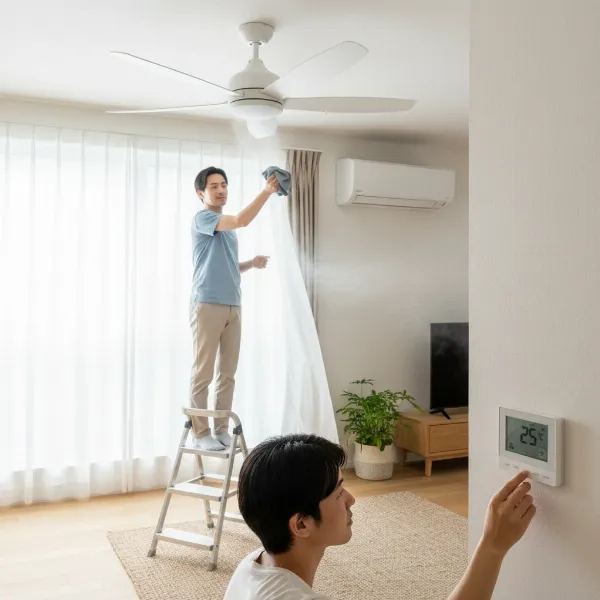 A person cleaning a fan or adjusting a thermostat, demonstrating energy-saving tips.
“While fans won’t lower a room’s temperature, they create a wind-chill effect that makes you feel cooler, often allowing you to raise your thermostat by a few degrees and save significantly on air conditioning costs.”
Conclusion
Electric fans are an undeniable champion in the quest for cost-effective cooling. From the personal breeze of a desk fan to the widespread circulation of a ceiling fan, their energy consumption remains remarkably low, making them a smart alternative or complement to more power-hungry air conditioning systems. By understanding the wattage of different fan types, implementing simple energy-saving habits like using lower speeds and turning them off in empty rooms, and making informed choices when purchasing, you can significantly reduce your energy costs. Investing in ENERGY STAR certified models or fans with efficient DC motors further enhances these savings, proving that staying cool doesn’t have to come with a hefty price tag.
What smart cooling strategies will you adopt this season to keep your home comfortable and your wallet happy?
Frequently Asked Questions
How much does it cost to run a fan 24/7?
Running a typical 75-watt electric fan 24/7 at an average electricity rate of $0.15/kWh would cost approximately $0.01 per hour, totaling about $7.20 per month. This cost can vary slightly based on the fan’s exact wattage and your local electricity rate.
Are DC motor fans really more energy-efficient?
Yes, fans equipped with DC (Direct Current) motors are significantly more energy-efficient than traditional AC (Alternating Current) motor fans. They can use 40-70% less electricity, offering quieter operation and more precise speed control, leading to substantial long-term savings on your energy bill.
Can running a fan and AC together actually save money?
Absolutely. Using fans in conjunction with your air conditioning allows you to raise your AC thermostat setting by 3-4°F (1.5-2°C) without feeling warmer. This reduces the energy demand on your AC unit, which is typically your home’s largest energy consumer, leading to overall lower cooling costs by 20-40%.
How do I find my fan’s wattage?
You can usually find your fan’s wattage listed on a label or sticker located on the fan itself (often on the bottom, back, or motor housing), or in the product’s user manual. If only amperage (A) and voltage (V) are provided, you can estimate wattage by multiplying them (Watts = Amps × Volts).
What’s the average lifespan of an energy-efficient fan?
The average lifespan of a well-maintained electric fan, particularly those with durable motors and construction, typically ranges from 5 to 10 years. High-quality fans, especially those with energy-efficient DC motors, can often last 15-20 years with proper care and regular cleaning.