Dealing with wet floors, whether from a spill, a deep clean, or an unexpected leak, can be a major headache. Beyond the immediate inconvenience, lingering moisture poses serious risks, from slip hazards to potential mold growth and structural damage. While a standard household fan might offer some relief, it often falls short when true drying power is needed. This is where high-velocity fans, often called air movers, become indispensable. Designed to rapidly accelerate evaporation, these powerful machines are your secret weapon for quickly restoring floors to a dry, safe state. In this comprehensive guide, we’ll dive into everything you need to know about selecting, using, and maintaining the best high-velocity fan for efficiently drying floors.
Understanding High-Velocity Fans for Floor Drying
When faced with dampness, understanding the tools that can tackle the job efficiently is crucial. High-velocity fans are not merely powerful versions of your everyday cooling fan; they are specialized equipment engineered for drying.
What Are High-Velocity Fans (Air Movers)?
High-velocity fans, commonly known as air movers or floor drying fans, are professional-grade blowers built to generate a concentrated, high-speed airflow across surfaces. Unlike typical fans that circulate air for comfort, air movers are designed with a singular purpose: to rapidly evaporate moisture from floors, carpets, walls, and other damp areas. They are essential tools for water damage restoration professionals, cleaning crews, and even homeowners managing significant spills or post-cleaning drying tasks. Their ability to quickly remove moisture helps prevent costly secondary damage like warping, mildew, and microbial growth, safeguarding your property and health.
How Do They Work?
The effectiveness of high-velocity fans stems from a simple yet powerful principle: accelerating evaporation through enhanced airflow and targeted pressure. When a surface is wet, moisture molecules cling to it. An air mover works by creating a powerful, directed stream of air that continuously sweeps across this wet surface. This constant airflow disrupts the boundary layer of saturated air directly above the moisture, carrying away evaporated water molecules and replacing them with drier air. This continuous exchange dramatically increases the rate at which moisture can evaporate into the atmosphere. The higher the volume and velocity of air an air mover can deliver, the faster it can facilitate this crucial drying process, turning days of natural drying into mere hours.
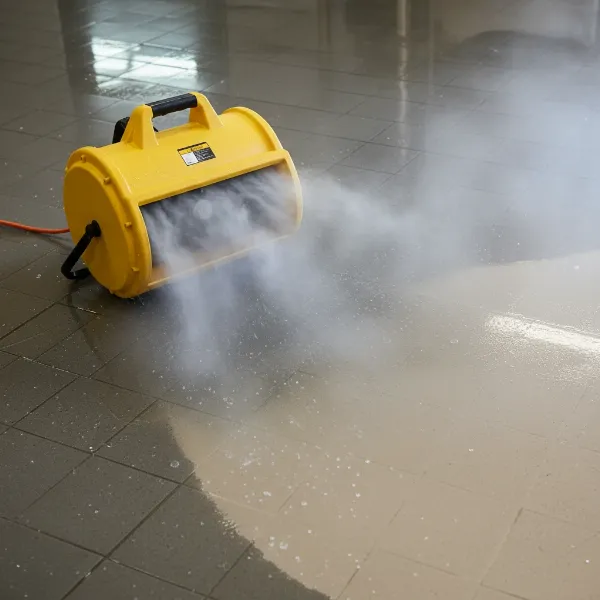 High-velocity fan rapidly drying a wet floor surface, showing evaporation process
Types of High-Velocity Fans for Drying Floors
Not all high-velocity fans are created equal. Different designs offer distinct advantages for various drying scenarios. Understanding these types will help you choose the most effective tool for your specific needs.
Centrifugal (Snail) Air Movers
Centrifugal air movers, often recognizable by their “snail shell” design, are powerhouse fans that excel at delivering focused, high-pressure airflow. They draw air in from their side and push it out at a 90-degree angle, making them ideal for targeted drying.
- Pros: They provide intense, concentrated airflow perfect for drying specific areas, such as along walls, under cabinets, or directly onto wet carpets. Many models feature multiple positioning angles (e.g., 0°, 45°, 90°) to direct air precisely. Their durable construction makes them a staple in water damage restoration.
- Cons: Centrifugal fans can often be louder than axial models and may consume slightly more power for a given airflow. Their airflow pattern is less spread out, requiring more units or careful repositioning for large open spaces.
- When to Use: Best for drying carpets, walls, subfloors, and in confined areas where precise, high-pressure airflow is needed to drive moisture out. They are excellent for post-flood cleanup and targeted spot drying.
Axial Air Movers
Axial air movers resemble more traditional fans but are built for industrial-grade performance. They draw air in parallel to their motor and push it straight out, creating a wide, high-volume airflow pattern.
- Pros: These fans move a massive volume of air (high CFM) over a larger area, making them highly efficient for drying wide-open spaces. They tend to be more energy-efficient and often quieter than centrifugal fans for comparable airflow volume. Their design often allows for easy stacking, making storage and transport convenient.
- Cons: The airflow is less focused, which might be less effective for extremely saturated, targeted areas or structural drying tasks where deep penetration is needed.
- When to Use: Ideal for drying large rooms, basements, garages, or open commercial spaces where broad coverage is paramount. They are excellent for general ventilation and accelerating ambient drying after initial water extraction.
Low-Profile Floor Dryers
Low-profile floor dryers are a specialized category, often axial or a hybrid design, built with a compact, flat form factor that allows them to be placed directly on the floor.
- Pros: Their design ensures maximum airflow contact with the floor surface, optimizing evaporation for carpets and hard floors. They are typically compact, lightweight, and many are stackable for easy storage and transportation. Many feature built-in outlets for daisy-chaining multiple units.
- Cons: Their primary limitation is their inability to effectively direct airflow upwards or at acute angles, making them less versatile for wall or ceiling drying.
- When to Use: Perfect for drying freshly cleaned carpets, spilled liquids on hard floors, or localized wet spots in homes and commercial settings. Their discreet design is also beneficial in occupied spaces where larger blowers might be obtrusive.
Comparison Table: High-Velocity Fan Types
| Feature | Centrifugal Air Mover (Snail) | Axial Air Mover | Low-Profile Floor Dryer |
|---|---|---|---|
| Airflow Pattern | Focused, high-pressure, directional | Broad, high-volume, straight flow | Direct, close-to-surface |
| CFM Range | Moderate to High (e.g., 500-2500) | High to Very High (e.g., 1000-4000+) | Moderate to High (e.g., 600-2000) |
| Noise Level | Generally louder | Often quieter for comparable CFM | Varies, can be moderate |
| Typical Use | Targeted, structural, carpet drying | Large open areas, general ventilation | Floor-specific, carpet drying |
| Portability | Moderate (often heavier, bulkier) | High (often stackable, lighter) | Very High (compact, stackable) |
| Versatility | Good for various angles | Best for open spaces | Limited angles, floor-focused |
Key Features to Look for in a High-Velocity Floor Drying Fan
Choosing the right high-velocity fan means looking beyond just the price tag. Several features directly impact a fan’s effectiveness, durability, and user convenience.
Airflow Power (CFM)
Cubic Feet per Minute (CFM) is perhaps the most critical specification for any drying fan, indicating the volume of air the unit moves per minute. A higher CFM rating generally translates to faster drying times, as more air is constantly sweeping moisture away from the surface. For home use, a fan with 500-1000 CFM might suffice for small spills. For water damage restoration or larger areas, look for units with 1200 CFM or higher, with some industrial models reaching 3600 CFM or more.
Motor & Speed Settings
The motor is the heart of the air mover, determining its power and longevity. Look for durable, high-horsepower motors, especially if you plan for heavy use. Multiple speed settings are highly beneficial, allowing you to adjust the airflow intensity. Lower settings can be used for delicate surfaces or initial drying to avoid excessive turbulence, while high settings provide maximum drying power when needed. This versatility ensures you can optimize drying for different materials and situations.
Durability & Construction
High-velocity fans are often used in demanding environments, so robust construction is essential. Consider models made from impact-resistant roto-molded plastic or heavy-duty metal housings that can withstand bumps, drops, and the rigors of job sites. Features like sealed motors protect against moisture and debris, extending the fan’s lifespan.
Portability & Design
For many users, especially professionals, portability is key. Look for features like integrated carrying handles, lightweight designs, and compact footprints. Stackable units save valuable storage space in garages or work vans. Some larger models even include wheels and telescopic handles, making them easy to move between locations without strain.
Adjustable Positioning
The ability to direct airflow precisely is crucial for effective drying. Many high-velocity fans offer multiple positioning options, such as horizontal, 45-degree, and vertical angles, or even 360-degree rotation. This allows you to target specific wet spots, dry under furniture, or distribute air evenly across a room.
Noise Level
While powerful fans are inherently louder than standard models, some high-velocity fans are engineered for quieter operation. Noise levels are measured in decibels (dBA); lower numbers are better. If the fan will be used in occupied spaces, a unit under 70 dBA (which is roughly the sound of a normal conversation or vacuum cleaner) might be preferable, though professional-grade units can exceed this. Balance the need for power with noise tolerance.
Energy Efficiency
Running fans for extended periods can impact electricity bills. Check the fan’s amperage (amp draw) to gauge its energy consumption. Many modern air movers are designed to be energy-efficient, offering powerful airflow with lower amp draws, which is also beneficial for daisy-chaining multiple units without tripping circuits.
Safety Features
Safety is paramount, especially when working with water and electricity. Look for fans with built-in GFCI (Ground Fault Circuit Interrupter) outlets, which provide protection against electrical shock. A circuit breaker with a reset button is also a valuable safety feature, preventing overload when multiple devices are connected. Non-conductive materials for the housing further enhance safety.
Daisy-Chain Capability
Some professional-grade air movers include auxiliary outlets that allow you to “daisy-chain” multiple units together using a single power cord plugged into the wall. This feature is incredibly convenient for drying large areas or multiple rooms, as it reduces the number of extension cords and wall outlets required, streamlining setup and preventing clutter.
Choosing the Right High-Velocity Fan for Your Needs (Buying Guide)
Selecting the ideal high-velocity fan depends on your specific circumstances and priorities. Here’s a guide to help you make an informed decision:
Assess Your Drying Task
- Home Use (Spills, Cleaning): For occasional small spills, drying after mopping, or accelerating carpet cleaning, a compact, versatile low-profile or smaller axial fan with moderate CFM might be sufficient. You may prioritize quieter operation and ease of storage.
- Commercial/Water Damage Restoration: For significant water damage, flood restoration, or professional cleaning, prioritize high CFM, robust durability, multiple positioning options, and daisy-chain capability. Centrifugal or high-power axial fans are typically preferred.
Consider the Area Size
- Small Rooms/Targeted Spots: A smaller centrifugal air mover or a compact low-profile dryer is often best for focused drying in confined spaces, bathrooms, or hallways.
- Large Open Spaces: Axial air movers are designed to move large volumes of air across broad areas like basements, garages, or open-plan living rooms. For very large areas, consider multiple units.
Budget
High-velocity fans vary widely in price.
- Entry-level: You can find decent models for home use in the $100-$200 range.
- Mid-range: Professional-grade units with better features, durability, and higher CFM typically range from $200-$500.
- High-end: Specialized restoration equipment with advanced features, extreme durability, and very high performance can exceed $500.
Invest as much as your budget allows, prioritizing features that directly impact your primary use case.
Brand Reputation & Reviews
Research reputable brands known for quality and performance in the air mover industry. Brands like XPOWER, Lasko, DEWALT, B-Air, Dri-Eaz, and Phoenix/Viking are frequently mentioned for their reliable products. Read user reviews to gauge real-world performance, durability, and common issues.
Warranty & Support
A good warranty indicates a manufacturer’s confidence in their product. Check the warranty period and what it covers. Accessible customer support is also valuable for troubleshooting or parts replacement.
Top Brands for High-Velocity Floor Drying Fans
The market offers several reputable brands known for manufacturing high-quality high-velocity fans and air movers. Each often brings its unique strengths to the table, catering to different needs and budgets.
- XPOWER: A leading brand, XPOWER offers a wide range of air movers, from compact mini-dryers to powerful industrial axial fans. They are known for their innovative designs, including stackable units, variable speed controls, and robust construction. Many XPOWER models feature auxiliary outlets for daisy-chaining and are popular among professionals.
- Lasko: While Lasko produces a variety of fans, their high-velocity floor fans, like the B-Air Firtana-20X, are well-regarded for their powerful airflow and value. They offer models suitable for both residential and light commercial use, often featuring durable plastic housings and multi-angle positioning.
- DEWALT: Recognized for its job site equipment, DEWALT offers rugged and reliable portable air movers designed to withstand harsh work environments. Their fans are known for strong airflow, durable construction, and often feature built-in outlets for convenience on commercial sites.
- B-Air: Specializing in air movement equipment, B-Air manufactures a comprehensive line of air movers and dryers for restoration and commercial cleaning. Their products, such as the B-Air VP-50, are known for their powerful motors, stackable designs, and durable roto-molded housings, making them a favorite among professionals.
- Dri-Eaz: A premium brand in the water damage restoration industry, Dri-Eaz produces high-performance air movers and dehumidifiers. Their fans, including axial and centrifugal models, are engineered for maximum drying efficiency, durability, and often feature advanced controls and robust safety features, albeit at a higher price point.
- Phoenix/Viking: These brands are often associated with high-efficiency drying systems, including advanced air movers that prioritize both powerful airflow and low amperage draw. They are a go-to for restoration specialists seeking optimal performance and energy efficiency.
When considering a brand, look at their specific models, read recent reviews, and compare specifications to ensure the fan aligns with your intended use.
Tips for Effective Use and Maintenance
Maximizing the effectiveness and lifespan of your high-velocity fan involves more than just plugging it in. Proper usage and routine maintenance are key.
Optimal Placement
Strategic placement is crucial for rapid drying.
- Targeted Drying: Place the fan directly facing the wet area, ensuring the high-velocity airflow is concentrated on the moisture.
- Large Areas: For extensive wet floors, use a grid pattern with multiple fans, positioning them about 10-15 feet apart to create a consistent air current across the entire surface.
- Corners and Edges: Don’t forget hard-to-reach areas. Adjust fan angles to push air into corners, under cabinets, and along baseboards where moisture tends to linger.
- Avoid Ripples on Finishes: If drying a freshly applied floor finish, angle the air mover slightly away from the surface to circulate air gently around the room, rather than pointing it directly, which can cause ripples or bubbling.
Combine with Dehumidifiers
For the most efficient drying, especially after significant water damage, pair your high-velocity fans with a dehumidifier. The fans evaporate moisture from the surface into the air, while the dehumidifier extracts that moisture from the air, preventing re-saturation and significantly speeding up the overall drying process. This combination creates a powerful drying system.
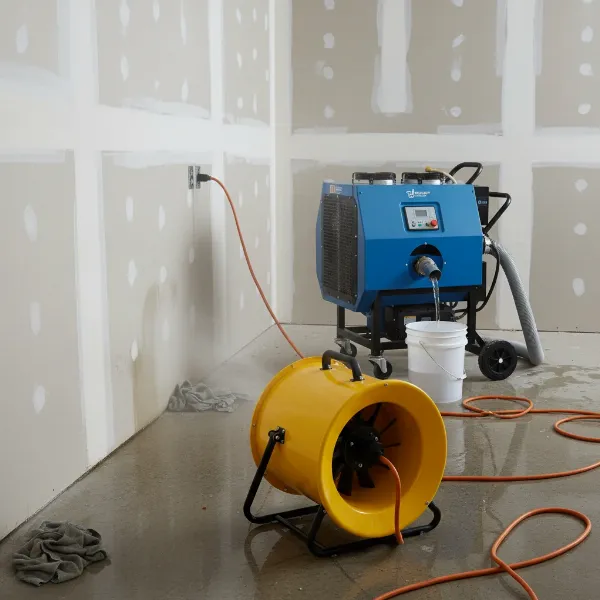 Air mover and dehumidifier working together to dry a room
Cleaning & Storage
Regular maintenance ensures your fan operates at peak performance and lasts longer.
- Regular Cleaning: Dust and debris can accumulate on grilles and blades, reducing airflow efficiency and potentially overheating the motor. Unplug the fan and use a vacuum or damp cloth to clean the exterior and air intake/exhaust grilles regularly. Some models allow for easy removal of grilles for deeper cleaning of the blades.
- Inspect Cords: Routinely check power cords for any signs of damage, fraying, or exposed wires. Replace damaged cords immediately to prevent electrical hazards.
- Proper Storage: When not in use, store your high-velocity fan in a clean, dry place. Stackable designs are excellent for maximizing storage efficiency. Keep it away from extreme temperatures and moisture to prevent damage to internal components.
Troubleshooting Common Issues
- Fan Not Turning On: Check the power cord connection, ensure the outlet is functional, and verify if the circuit breaker (on the unit or electrical panel) has tripped.
- Reduced Airflow: Clean the fan grilles and blades to remove any obstructions or dust buildup.
- Unusual Noises: Investigate for loose parts, debris inside the fan housing, or potential motor issues. If the noise persists or is accompanied by burning smells, discontinue use and seek professional inspection.
Conclusion
High-velocity fans are invaluable tools for anyone needing to dry floors quickly and effectively, whether tackling a small spill at home or managing a large-scale water damage restoration project. By understanding the different types—centrifugal, axial, and low-profile—and carefully considering key features like CFM, durability, portability, and safety, you can select the perfect air mover to meet your demands. Proper usage and consistent maintenance will ensure your investment provides fast, efficient drying for years to come, helping to prevent costly damage and maintain a safe, healthy environment.
Don’t let wet floors become a lasting problem. Invest in the right high-velocity fan and take control of your drying challenges. What’s the most unexpected place you’ve found a high-velocity fan to be indispensable?
Frequently Asked Questions
Are high-velocity fans the same as regular fans?
No, high-velocity fans (air movers) are specifically engineered for rapid drying and ventilation, moving a much larger volume of air at a higher speed and with more focused pressure than standard household fans, which are primarily designed for personal cooling or general air circulation.
How long does it take to dry a floor with a high-velocity fan?
Drying time varies greatly depending on the fan’s power (CFM), the type of flooring, the extent of the wetness, and ambient humidity. However, high-velocity fans can dramatically reduce drying times from days to often just a few hours for typical spills or post-cleaning dampness, especially when combined with a dehumidifier.
Can I use a regular box fan instead?
While a regular box fan can help with air circulation, it lacks the focused power and high CFM of a dedicated high-velocity fan or air mover. It will be significantly less effective and take much longer to dry wet floors, potentially leading to mold growth or further damage.
What is CFM and why is it important for drying?
CFM stands for Cubic Feet per Minute and measures the volume of air a fan moves. For drying, a higher CFM is crucial because it indicates the fan’s ability to replace saturated air over a wet surface with drier air more rapidly, thereby accelerating the evaporation process and speeding up drying times.
How many high-velocity fans do I need for a room?
The number of fans needed depends on the room size, the degree of wetness, and the type of flooring. For general drying, professionals often recommend one air mover for every 100-200 square feet, or strategically placed units every 10-15 feet to create a strong, consistent airflow pattern across the entire wet area.
Are high-velocity fans loud?
Yes, due to their powerful motors and high airflow, high-velocity fans are generally louder than standard household fans. While some models are designed with noise reduction features, a certain level of operational sound is inherent to their high-performance design. Noise levels are typically listed in decibels (dBA).