As temperatures rise, finding the right electric fan to keep your home comfortable becomes a top priority. With countless options available, from majestic ceiling fans to versatile portable models, understanding which one offers superior efficiency for your unique needs is crucial. This detailed guide explores the nuances of ceiling fans and portable fans, helping you make an informed decision for optimal comfort and energy savings.
Understanding Electric Fans: How They Cool
Electric fans operate on a simple yet effective principle: they don’t actually lower the ambient temperature of a room. Instead, they create a cooling sensation by circulating air. This moving air accelerates the evaporation of moisture from your skin, which is how your body naturally cools itself. By creating a “wind-chill” effect, fans can make a room feel several degrees cooler, allowing you to potentially raise your thermostat settings and reduce reliance on more energy-intensive air conditioning systems.
The Ceiling Fan: Your Room’s Steady Breeze
Ceiling fans are fixed fixtures, typically mounted in the center of a room’s ceiling. They feature large blades designed to rotate and move air downward (or upward in winter with a reversible motor), creating a broad and consistent airflow throughout the entire space. These electric fans come in various styles and sizes, becoming an integral part of a room’s decor.
Advantages of Ceiling Fans
Ceiling fans excel at providing widespread air circulation, making them ideal for cooling larger rooms or open-plan areas. Their overhead placement means they don’t occupy any floor space, contributing to a clean and uncluttered environment. Many modern ceiling fans also feature reversible motors, allowing them to push warm air down from the ceiling in winter, helping to distribute heat more evenly. When used in conjunction with air conditioning, a ceiling fan can significantly improve comfort, allowing you to set your AC thermostat higher and reduce energy consumption.
Disadvantages of Ceiling Fans
The primary drawbacks of ceiling fans include their fixed nature and the need for professional installation, which can incur higher upfront costs. Once installed, they offer less targeted cooling compared to portable models, as their airflow is designed for general room circulation rather than a direct personal breeze. They also lack portability, confining their cooling effect to a single room.
When to Choose a Ceiling Fan
A ceiling fan is an excellent choice for homeowners seeking a permanent, integrated cooling solution for large living areas, bedrooms, or dining rooms. If you aim to enhance overall room comfort, reduce your air conditioning load, and appreciate a fan that doubles as a stylish fixture, a ceiling fan is likely your best electric fan option. They are also a safer choice in homes with children or pets, as they are out of reach.
 Elegant ceiling fan circulating air in a spacious living room, providing ambient cooling.
The Portable Fan: Flexible and Focused Cooling
Portable fans encompass a wide range of electric fan types, including table fans, desk fans, standing (pedestal) fans, box fans, and tower fans. As their name suggests, they are designed for mobility and can be easily moved from one room to another or repositioned for targeted cooling.
What is a Portable Fan?
Portable fans are self-contained units that can be plugged into any standard electrical outlet. They come in various sizes and designs, each suited for different personal or localized cooling needs. Table and desk fans are compact, perfect for personal workstations. Standing fans offer adjustable height and oscillation for cooling a small group, while box and tower fans often provide more robust airflow for slightly larger, though still localized, areas. These electric fan types are characterized by their flexibility and immediate usability.
Advantages of Portable Fans
The most significant advantage of portable fans is their unparalleled flexibility. You can move them wherever cooling is needed most, whether it’s your bedside, home office, or a patio. They provide highly targeted airflow, offering immediate relief to an individual. Portable fans are generally more affordable than ceiling fans and require no installation—simply plug them in and enjoy. Their lower individual wattage also makes them attractive for specific personal cooling needs.
Disadvantages of Portable Fans
Portable fans take up floor or surface space, which can be an issue in smaller rooms. While great for personal cooling, they are less effective at circulating air throughout an entire large room. They can also be noisier than ceiling fans, especially at higher settings, and may be less durable over the long term compared to a well-installed ceiling fan. In homes with young children or pets, care must be taken to prevent accidents.
When to Choose a Portable Fan
Opt for a portable fan if you live in a small apartment, rent your home, or primarily need personal, on-demand cooling. They are perfect for targeting a specific area, like your desk while you work or your bed while you sleep. If budget is a major concern or you appreciate the ability to move your cooling source freely, a portable electric fan is an excellent choice.
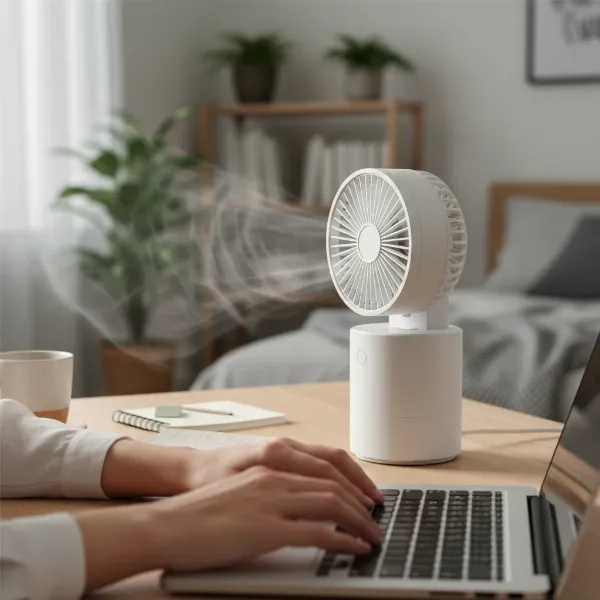 Compact portable desk fan providing direct, focused airflow to a person working at a desk.
Efficiency Showdown: Which Fan Wins?
When comparing the efficiency of an electric fan, it’s essential to look beyond just wattage and consider the intended use and overall impact.
Energy Consumption: Watts and Kilowatt-Hours
In terms of raw power consumption, portable fans often draw fewer watts than ceiling fans individually. A typical small desk fan might use 5-30 watts, while a larger standing or box fan could range from 40-100 watts. In comparison, a standard ceiling fan usually consumes between 50-100 watts per hour, though high-efficiency DC motor models can be as low as 10-30 watts.
However, “efficiency” is contextual. While a portable fan uses less electricity if directed at one person, a ceiling fan effectively cools an entire room, potentially allowing you to raise your air conditioner’s thermostat by a few degrees. For instance, a ceiling fan running for 12 hours at 75 watts uses approximately 0.9 kWh per day. A table fan operating for 8 hours at 40 watts uses about 0.32 kWh per day. The total energy savings often comes from reducing reliance on much higher-wattage air conditioning units (which typically consume 500-3500 watts).
Cooling Effectiveness: Coverage vs. Concentration
Ceiling fans provide superior whole-room air circulation, creating a consistent breeze across a larger area. This makes the entire room feel more comfortable. Portable fans, conversely, excel at providing a concentrated, direct breeze to a specific spot, offering intense personal cooling. If your goal is to cool a large space, a ceiling fan is more effective at maximizing comfort across the room, making it more efficient for widespread cooling. For individual comfort, a portable fan delivers cooling more directly and efficiently to you.
Cost-Effectiveness: Beyond the Price Tag
Portable fans typically have a lower upfront cost and require no installation, making them more budget-friendly initially. Ceiling fans, while having a higher initial purchase price and installation cost, can offer long-term savings by significantly reducing your air conditioning usage over time. Their durability also often translates to a longer lifespan, further contributing to their long-term value.
Environmental Impact
Both types of electric fans are considerably more eco-friendly than air conditioners. By using fans to mitigate the need for AC or to allow for higher thermostat settings, you reduce your overall carbon footprint. Choosing energy-efficient models with features like DC motors or ENERGY STAR certification further enhances their environmental benefits.
Comparison Table: Ceiling Fan vs. Portable Fan
| Feature | Ceiling Fan | Portable Fan (Table, Standing, Box) |
|---|---|---|
| Energy Use (W) | 10-100W (avg. 50-100W) | 5-100W (avg. 30-75W depending on type/size) |
| Coverage | Whole-room air circulation | Targeted, personal cooling |
| Portability | Fixed | Highly portable (easy to move between rooms) |
| Installation | Professional installation often required | None (plug-and-play) |
| Upfront Cost | Higher (unit + installation) | Lower |
| Operating Cost | Can be lower overall by reducing AC use | Low for personal use, higher if multiple needed for room |
| Ideal Use | Large rooms, consistent ambient cooling, AC support | Small rooms, personal cooling, temporary needs |
| Noise Level | Generally quieter at low speeds | Can be noisier, especially at higher settings |
| Durability | Generally more durable and long-lasting | Varies, often less durable than fixed options |
Choosing Your Ideal Fan: Key Considerations
Selecting the right electric fan depends on a blend of practical factors and personal preferences.
Room Size and Layout
For expansive living areas, open-concept spaces, or rooms with high ceilings, a ceiling fan is usually the superior choice for effective air distribution. If you’re cooling a compact bedroom, a small office, or a specific seating area, a portable fan will deliver more efficient, localized relief.
Specific Cooling Needs (Ambient vs. Personal)
Determine if you need to cool the general ambient temperature of a room or if you desire a direct breeze for personal comfort. Ceiling fans excel at the former, creating a comfortable atmosphere throughout. Portable fans are unmatched for directed personal cooling.
Budget and Long-Term Value
While portable fans boast a lower initial price point, consider the long-term operating costs and durability. A more expensive, energy-efficient ceiling fan could save you more money on electricity bills over its lifespan by reducing your air conditioning usage.
Lifestyle and Aesthetic Preferences
If you appreciate a minimalist aesthetic or have limited floor space, a ceiling fan integrates seamlessly overhead. Portable fans, while practical, do occupy physical space and can sometimes detract from a room’s decor. Consider also the noise level; if you’re sensitive to sound, especially while sleeping, research fan models known for quiet operation.
Smart Features and Energy Ratings
Modern electric fans often come with smart features like remote controls, programmable timers, and even smart home integration. Look for ENERGY STAR-rated models, which are certified to be more energy-efficient, regardless of whether they are ceiling or portable fans. Features like DC motors in ceiling fans offer significant energy savings and quieter operation.
Maintaining Your Fan for Peak Efficiency
Regular maintenance ensures your electric fan operates effectively and lasts longer, providing consistent cooling without unnecessary energy consumption.
Regular Cleaning
Dust and dirt accumulate on fan blades and motor housings, reducing airflow and potentially straining the motor. For ceiling fans, wipe down blades and motor cover regularly. For portable fans, remove grilles and clean blades and motor vents as per the manufacturer’s instructions. A clean fan moves air more efficiently.
Proper Storage
If you won’t be using your portable fan for an extended period, clean it thoroughly and store it in a dry, dust-free place, ideally in its original packaging or a protective cover. For ceiling fans, a quick seasonal cleaning is usually sufficient.
Troubleshooting Common Issues
If your fan makes unusual noises or its airflow seems diminished, check for loose screws, wobbling blades (for ceiling fans), or obstructions. Ensure the fan is properly assembled and that its components are secure. Addressing minor issues promptly can prevent more significant problems and maintain efficiency.
Conclusion
Deciding between a ceiling fan and a portable fan ultimately depends on your specific cooling requirements, room size, and lifestyle. For comprehensive whole-room air circulation and long-term energy savings by supporting your AC, the ceiling fan stands out as an efficient choice. For flexible, targeted personal cooling and immediate affordability, the portable fan is unmatched. Both types of electric fan offer significant advantages over air conditioning alone, providing cost-effective and environmentally conscious ways to stay comfortable. By carefully considering your needs, you can select the most efficient electric fan that perfectly complements your home and keeps you cool all season long. Which fan will you choose to create your ideal indoor climate?
Frequently Asked Questions
Are ceiling fans always more energy-efficient than portable fans?
Not always, it depends on usage. Individually, many portable fans consume less wattage. However, a ceiling fan can be more energy-efficient for cooling an entire large room, potentially allowing you to reduce your air conditioning use, which is a much larger energy consumer. For personal, direct cooling, a low-wattage portable fan is highly efficient.
Can I use a portable fan to cool a large living room?
While a powerful portable fan can provide some airflow in a large living room, it won’t effectively circulate air throughout the entire space like a ceiling fan. Its cooling effect will be localized, making it less efficient for ambient room cooling compared to a ceiling fan designed for that purpose.
How do I know if my fan is energy efficient?
Look for an ENERGY STAR label, which indicates that the fan meets strict energy efficiency guidelines. For ceiling fans, models with DC motors are typically more efficient than those with traditional AC motors. Checking the wattage rating and comparing it with similar models can also give you an idea of its energy consumption.
What’s the best way to use a fan with air conditioning?
To maximize efficiency, use your electric fan in conjunction with your air conditioner. A fan creates a wind-chill effect, making the room feel cooler, which allows you to set your AC thermostat a few degrees higher. This reduces the AC’s workload and saves energy without sacrificing comfort. Remember to turn off fans when leaving a room, as they cool people, not spaces.
How often should I clean my fan’s blades?
Regular cleaning is key for efficiency. For frequently used fans, aim to clean the blades and motor housing every 1-2 months, or more often if you notice significant dust buildup. For ceiling fans, a quick dusting every few weeks can prevent accumulation, while portable fans might need more frequent attention due to their proximity to dust on surfaces.