In the quest for modern home comfort, bladeless fans have emerged as a sleek and efficient solution to beat the heat. Renowned for their innovative design and whisper-quiet operation, these devices offer a refreshing alternative to traditional fans with spinning blades. While Dyson has largely popularized this technology, their premium price tags often place them out of reach for many consumers. Fortunately, the market is now rich with high-quality, more affordable bladeless fan alternatives that deliver exceptional cooling performance without breaking the bank.
The Allure of Bladeless Technology
Bladeless fans operate on an ingenious principle, often referred to as “air multiplier” technology. A motor housed in the base draws in air, which is then accelerated and projected through a narrow aperture in the fan’s ring-shaped head. This creates a smooth, high-velocity jet of air that induces surrounding air to follow, resulting in a powerful and continuous stream of cool air. This innovative design offers several compelling advantages over conventional fans:
- Enhanced Safety: With no visible, fast-spinning blades, bladeless fans are inherently safer, making them ideal for homes with children and pets.
- Sleek Aesthetics: Their minimalist and futuristic appearance seamlessly integrates with modern home decor, often serving as a stylish statement piece.
- Quieter Operation: By eliminating blade chop, these fans produce a smoother, less turbulent airflow, significantly reducing noise levels compared to traditional models.
- Easier Maintenance: The absence of intricate grilles and blades means less dust accumulation and simpler cleaning—often just a quick wipe-down.
- Energy Efficiency: Many bladeless fans are designed with energy-efficient motors and optimized airflow, contributing to lower electricity bills.
Top 5 Bladeless Fan Alternatives That Aren’t Dyson
Looking for Dyson-level performance without the hefty price tag? These five bladeless fan alternatives offer compelling features and value, making them excellent choices for any budget.
1. Dreo Smart Tower Fan: The Smart Value Champion
Dreo has quickly become a standout brand, frequently praised for delivering premium features at an accessible price. Models like the Dreo Smart Tower Fan 519S or Nomad One consistently earn high marks for their performance and value.
- Key Features: These fans boast quiet operation, multiple speed settings (ranging from 4 to 9), and various modes such as sleep, auto, and natural breeze. Many come with a clear digital display, remote control, and oscillation capabilities (often 45 to 90 degrees). Advanced models like the Dreo TurboPoly Fan offer impressive double oscillation, moving air both horizontally (up to 120 degrees) and vertically (up to 105 degrees) for comprehensive room coverage. Smart connectivity, including app control and compatibility with voice assistants like Alexa and Google Home, is available on select models.
- Pros: Dreo fans offer an exceptional balance of powerful cooling and quiet performance, making them suitable for bedrooms and living areas. Their smart features enhance convenience, while competitive pricing ensures excellent value.
- Cons: Some standard models may have a more limited oscillation range compared to Dyson’s widest sweep, and specific models might not be the most portable due to their design.
- Price Point: Typically ranging from $45 for basic models to around $130 for smart, feature-rich options, Dreo provides significant savings over Dyson.
|
Our Picks for the Best electric fan in 2026
As an Amazon Associate I earn from qualifying purchases.
|
||
| Num | Product | Action |
|---|---|---|
| 1 | Amazon Basics 20\" High Velocity Industrial Fan, Floor Fan, with 3 Speeds, Tilt Head, ETL-Listed Safety Compliance, Metal Housing/Blades, Ideal for Industrial/Commercial Space/Garage/Gym, 125W, Black |

|
| 2 | Amazon Basics 16\" Pedestal Fan with Remote, Floor Fan, Standing Fan for Bedroom, Living Room, Office, with 3 Speeds, 3 Modes, Timer, Dual-Layered Blades, Adjustable Height, Tilt Head, 60W, Black |
|
| 3 | Dreo Tower Fan for Bedroom, 90° Oscillating Standing Fans for Room with 4 Speeds, 3 Modes, 28dB Quiet for Sleep, 25ft/s Velocity, 8H Timer, Remote, Living Room, Office, Home, Black |
|
| 4 | 10\" Modern Standing Fan for Bedroom, Sleek Oscillating Pedestal Fan, 3-Speed & Height Adjustable Compact Floor Fan for Home Office & Dorm |
|
| 5 | LEVOIT Tower Fan for Bedroom, 25ft/s Velocity Standing Fan with 28dB Quiet for Sleep, Remoter, 12H Timer, 5 Speeds, 4 Modes, 90° Oscillation for Home, Office, Indoor, Bladeless 36 inch, White |
|
| 6 | Dreo Fan for Bedroom, 120° Oscillating Standing Fans, Quiet Floor Fan with DC Motor, 100ft Pedestal Fans for Room, 9 Speeds, 4 modes, 20dB, 120° Manual Vertical, 37-42\" Adjustable Height, 9H Timer |
|
| 7 | Dreo Fan for Bedroom, 12 Inches, 70ft Powerful Airflow, 28db Quiet Table Air Circulator Fans for Whole Room, 120° Adjustable Tilt, 3 Speeds, Desktop Fan for Home, Office, Kitchen |
|
| 8 | Amazon Basics Air Circulator Fan, Desk Fan for Bedroom, Home and Office, With 90-Degree Tilt Head, 3 Speed Settings, Lightweight (3 LBS), 35 Watts, Black, 11.1\"W x 6.3\"D x 10.9\"H |
|
| 9 | Lasko 2520 Oscillating Stand Fan,White 16 Inch |
|
| 10 | Dreo Tower Fan for Bedroom, 25ft/s Velocity Quiet Floor Fan, 90° Oscillating Fans for Indoors with 4 Speeds, 4 Modes, 8H Timer, Standing Fans, Bladeless Fan, Black, Nomad One (DR-HTF007) |
|
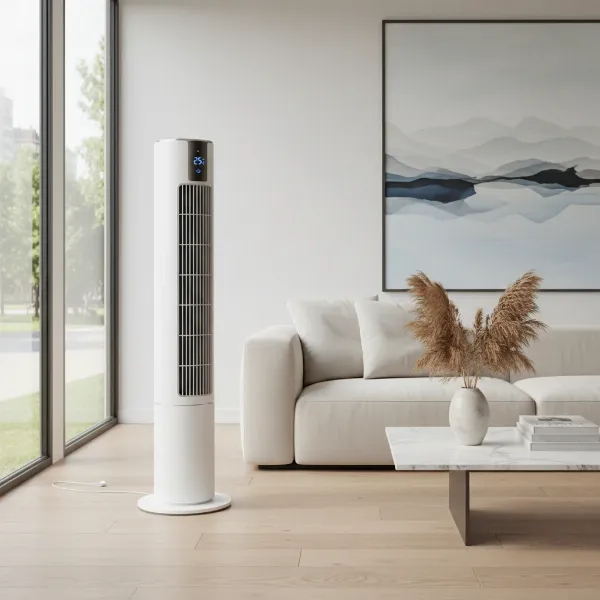 A sleek Dreo Smart Tower bladeless fan in a modern living room setting, showcasing its digital display and tall, elegant design.
2. Shark TurboBlade Tower Fan / FlexBreeze: Innovative Design for Versatile Cooling
Shark, known for its household innovations, offers bladeless fan options that stand out with unique designs and versatile functionality. The TurboBlade Tower Fan and the FlexBreeze Portable Fan are prime examples.
- Key Features: The Shark TurboBlade Tower Fan features a pivotable design, allowing it to be oriented horizontally or vertically for targeted airflow, and offers up to 10 speeds with 180-degree oscillation. Its adjustable vents and a “Natural Breeze” mode mimic outdoor air currents. The Shark FlexBreeze is an ultra-versatile fan that can switch between pedestal and tabletop configurations, be used corded or cordless (with up to 24 hours of battery life on the lowest setting), and even includes an ingenious mister attachment for outdoor cooling when connected to a water source.
- Pros: These fans excel in highly adjustable airflow, making them ideal for large spaces or precise cooling (e.g., directed at a bed). The FlexBreeze’s portability, cordless operation, and misting function add unique value. They often deliver powerful blasts of air.
- Cons: On higher settings, some Shark fans can produce noticeable noise. Certain models might lack advanced smart features or app control. The FlexBreeze, while versatile, may have fewer speed options than some competitors.
- Price Point: Ranging from $129 for the TurboBlade to around $159-$199 for the FlexBreeze, these are mid-to-higher-end alternatives, still substantially cheaper than Dyson.
3. Lasko Wind Curve Tower Fan: The Reliable Budget Pick
Lasko has a long-standing reputation for producing dependable and affordable fans. The Lasko Wind Curve Tower Fan is an excellent example of a basic yet highly effective bladeless-style fan for budget-conscious buyers.
- Key Features: This fan offers straightforward operation with three powerful speed settings, oscillation to distribute air, and often comes with a remote control and a 7.5-hour timer. Some models feature a wood-paneled look, blending well with various interiors. The Lasko FH500 model even combines fan and space heater functionality for year-round utility.
- Pros: The Lasko Wind Curve is exceptionally affordable, providing reliable cooling and good airflow for its price. It’s often quiet on its lower settings, making it suitable for offices or small rooms. Its simple controls appeal to users who prefer straightforward functionality.
- Cons: With only three speed settings, it offers less customization than more advanced fans. Some users might find its design bulkier, and on higher settings, it can be louder than premium alternatives. Its airflow might also be shorter than some pricier models.
- Price Point: Typically priced between $50 and $74, the Lasko Wind Curve provides an excellent entry-level option for those seeking effective cooling without a large investment.
4. Honeywell QuietSet Mini Tower Fan / Whole Room Bladeless Fan: Compact Comfort & Quiet Operation
Honeywell is a trusted name in home appliances, and their bladeless fan offerings focus on quiet performance and user-friendly features, particularly for personal or bedroom use.
- Key Features: The Honeywell QuietSet Mini Tower Fan is compact, featuring 4-5 quiet speed settings designed for various needs (e.g., “sleep,” “calm,” “white noise”). It includes an auto shut-off timer and oscillation. The larger Honeywell Whole Room Bladeless Fan offers similar quiet operation with up to 8 speeds, a remote control, and auto-dimming display lights perfect for nighttime.
- Pros: These fans are renowned for their exceptionally quiet operation, making them ideal for bedrooms, nurseries, or offices where minimal disturbance is crucial. The mini version is highly portable and perfect for tabletops, while the whole-room model offers broader coverage with convenient features like a remote.
- Cons: The QuietSet Mini lacks a remote control. The base of the larger Whole Room fan has been noted as potentially wobbly by some users, and its power might be less suited for very large spaces.
- Price Point: The QuietSet Mini is a steal at $29-$37, while the Whole Room Bladeless Fan is also highly affordable at $57-$75.
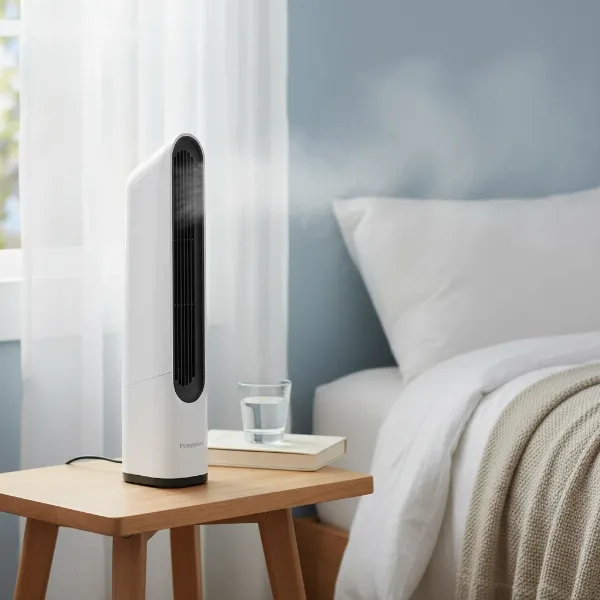 A compact Honeywell QuietSet Mini bladeless tower fan on a bedside table, providing a gentle breeze in a calm bedroom setting.
5. Antarctic Star Portable Electric Oscillating Fan: Ultimate Portability on a Budget
For those prioritizing extreme affordability and portability, the Antarctic Star Portable Electric Oscillating Fan offers a compelling solution without sacrificing core functionality.
- Key Features: This budget-friendly fan includes an on-unit temperature display, three speed settings, 85-degree oscillation, and a 12-hour timer. Its grated design is a key safety feature, protecting fingers from the internal rotating core, and it is lightweight and portable for easy movement.
- Pros: As one of the most budget-friendly bladeless fan options available, it provides essential features like oscillation and a timer. Its portability and safety features make it practical for households with kids or pets, and it comes with a temperature indicator for added convenience.
- Cons: With only three speed modes, it offers less versatility than other fans. Its noise level, at around 40 dB, might be noticeable to some, especially on higher settings.
- Price Point: Priced at approximately $65, the Antarctic Star fan is an excellent choice for those needing an affordable and safe cooling solution on the go.
Comparing Bladeless Fan Alternatives: A Detailed Look
Here’s a quick comparison of our top non-Dyson bladeless fan alternatives:
| Feature | Dreo Smart Tower Fan (e.g., 519S) | Shark TurboBlade / FlexBreeze | Lasko Wind Curve Tower Fan | Honeywell QuietSet Mini / Whole Room | Antarctic Star Portable |
|---|---|---|---|---|---|
| Price Range (Approx.) | $45 – $130 | $129 – $299 | $50 – $74 | $29 – $75 | $65 |
| Noise Level (dB) | 25-48 dB | 40-65 dB | ~55 dB | Very Quiet (~34-48dB for WR) | 40 dB |
| Speed Settings | 4-9 speeds | 5-10 speeds | 3 speeds | 4-8 speeds | 3 speeds |
| Oscillation | 45-120° (horizontal/vertical) | 180° (horizontal/vertical) | Yes | Yes | 85° |
| Smart Features | App, Voice Control (on some) | Limited/None | None | Auto-dimming lights | Temp Display |
| Unique Selling Points | High value, quiet, smart tech | Versatile design, mister (FlexBreeze) | Ultra-affordable, simple | Whisper-quiet, compact (Mini) | Portable, budget-friendly, temp display |
Key Features to Consider When Buying Your Bladeless Fan
Choosing the right bladeless fan involves more than just aesthetics. Consider these crucial factors to ensure your selection perfectly matches your needs:
- Airflow Strength & Coverage: Evaluate whether you need personal cooling for a desk or a powerful unit to circulate air throughout an entire room. Bladeless fans vary in how far their airflow can reach, typically from 3 to 30 feet.
- Noise Levels: While generally quieter, some bladeless fans can still produce noticeable noise on higher settings. If you plan to use it in a bedroom or office, look for models operating in the 20-40 decibel range for minimal disturbance.
- Speed Settings & Modes: A wider range of fan speeds offers greater control over your comfort. Look for additional modes like “sleep,” “natural breeze,” or “auto” to adapt the fan’s operation to different situations.
- Oscillation: This feature determines how widely the fan distributes air. Higher oscillation angles (e.g., 90 degrees or more, or even vertical oscillation) ensure better whole-room air circulation.
- Smart Features & Controls: Convenience features like remote controls, programmable timers, app connectivity, and voice assistant compatibility can significantly enhance your user experience.
- Safety & Design: Beyond the inherent safety of bladeless fans, consider the stability of the base, especially if you have an active household. The fan’s aesthetic should also complement your interior design.
- Energy Efficiency: Many bladeless fans incorporate energy-efficient components, which is good for your wallet and the environment. Look for models that emphasize low power consumption.
- Additional Functionality: Some bladeless fans offer multi-purpose capabilities, such as integrated air purification (with HEPA filters), heating functions, or even misting features for extra cooling.
Your Bladeless Fan Buying Guide
Navigating the market for a non-Dyson bladeless fan can be straightforward with a clear approach. Here’s a simple guide to help you make an informed decision:
- Assess Your Needs: Start by defining the primary purpose and location of your fan. Is it for a small personal space, a large living room, or a bedroom? Do you need smart features, extreme quietness, or portability?
- Set a Budget: Bladeless fans come in a wide range of prices. Determine how much you’re willing to spend, keeping in mind that many excellent options exist for under $150.
- Read User Reviews: Gain insights from other buyers’ long-term experiences. Pay attention to comments regarding noise, actual cooling power, durability, and customer service.
- Check Key Specifications: Compare decibel ratings, number of speed settings, oscillation range, and any special features against your priorities.
- Consider Brand Reputation: While looking beyond Dyson, opt for reputable brands known for quality and reliability in the appliance market.
- Evaluate Warranty & Support: Understand the manufacturer’s warranty and customer support options, which can be crucial for any potential issues down the line.
Tips for Using and Maintaining Your Bladeless Fan
To ensure your bladeless fan performs optimally and lasts for years, follow these simple usage and maintenance tips:
- Strategic Placement: Position your fan in an unobstructed area to maximize airflow. For whole-room cooling, place oscillating fans in corners. For personal cooling, ensure direct airflow.
- Regular Cleaning: Though easier to clean than bladed fans, dust can still accumulate on the internal components and external surfaces. Wipe down the exterior regularly with a soft cloth. Check the air intake vents in the base for dust buildup and clean them as per the manufacturer’s instructions, often using a vacuum cleaner or a brush.
- Filter Replacement (If Applicable): If your bladeless fan includes air purification features, be diligent about replacing or cleaning its HEPA or activated carbon filters as recommended to maintain air quality.
- Optimal Settings: Experiment with different speed settings and modes to find the most effective and comfortable airflow for various times of day and room conditions. Utilize timers to save energy and ensure the fan doesn’t run unnecessarily.
- Safe Storage: When not in use, especially during off-seasons, store your bladeless fan in a clean, dry place to prevent dust accumulation and protect its components.
Conclusion
The pursuit of a cool and comfortable home no longer requires the premium investment often associated with Dyson’s bladeless technology. The market abounds with exceptional bladeless fan alternatives from brands like Dreo, Shark, Lasko, Honeywell, and Antarctic Star, each offering a unique blend of style, functionality, and affordability. By carefully considering your specific needs for airflow, noise level, smart features, and budget, you can easily discover a high-performing bladeless fan that not only enhances your comfort but also complements your living space. Don’t compromise on modern cooling; explore these cheaper alternatives today and elevate your home environment with a refreshing breeze.
Frequently Asked Questions
Are bladeless fans truly bladeless?
Despite the name, bladeless fans do contain blades. However, these blades are safely concealed within the fan’s base, drawing in air and amplifying it before expelling a smooth, continuous stream. You won’t see or touch any exposed blades, making them safer and more aesthetically pleasing.
Do bladeless fans really cool a room effectively?
Yes, modern bladeless fans are highly effective at circulating air and helping you feel cooler by promoting faster sweat evaporation from your skin. While most fans don’t actively lower the air temperature like an air conditioner, many advanced bladeless models generate powerful and consistent airflow that can significantly enhance comfort in a room.
Are bladeless fans more energy-efficient than traditional fans?
Many bladeless fans are designed with energy efficiency in mind, often consuming less power than conventional fans. Their optimized designs and motors contribute to lower electricity usage, making them a more eco-friendly and cost-effective cooling option over time, potentially saving up to 30% on energy.
How quiet are bladeless fans typically?
Bladeless fans are generally quieter than traditional fans due to the absence of visible spinning blades, which reduces disruptive “blade chop” noise. Many models operate within a 20 to 40 decibel range, with some achieving whisper-quiet levels of 25 dB or less, making them ideal for bedrooms or quiet workspaces.
Are bladeless fans safe for homes with pets and children?
Absolutely. One of the primary advantages of bladeless fans is their enhanced safety. Without exposed, fast-spinning blades, there’s no risk of accidental injury to curious fingers or pet paws, making them an excellent and worry-free choice for families.
How do I clean a bladeless fan?
Cleaning a bladeless fan is typically simpler than cleaning traditional fans. For the exterior, a quick wipe-down with a damp cloth is usually sufficient. For internal dust, manufacturers often recommend using a soft brush or a vacuum cleaner with a narrow attachment to clean the air intake vents in the base. Always refer to your fan’s specific user manual for detailed cleaning instructions.